

Could the cleaning method that seems most thorough put your appliance’s fit at risk? If you’re concerned about odor, residue, or buildup, it’s natural to want to scrub harder or reach for a familiar cleaner. But cleaning a mandibular advancement device safely means keeping it clean while respecting its materials and design.
A simple routine can help you care for your device without guessing which products or tools are appropriate. This guide covers cleaning and storage, why hot water, abrasive toothpaste, and unapproved cleaners may cause problems, and how to follow the directions for your specific appliance. It also explains what changes in fit or condition are worth discussing with a dental professional. Care recommendations can vary by device, so guidance should account for its design and your experience. Beyond Dentistry NYC provides sleep apnea appliances and dental guidance in New York to help you care for your device with greater confidence.
Key Takeaways
- A mandibular advancement device is worn during sleep as an oral appliance for sleep apnea treatment, so regular care helps remove saliva and surface residue.
- For cleaning a mandibular advancement device, follow its instructions for removal, water temperature, and approved cleaning method.
- Toothpaste, bleach, boiling water, and soaking are not universal cleaning choices. Check your appliance’s care directions before using them.
- Follow the appliance’s storage directions and inspect it for visible cracks, loose components, or an unexpected change in fit.
- Care guidance should reflect your device and experience, especially when cleaning concerns overlap with comfort or fit.
Why cleaning a mandibular advancement device matters
A mandibular advancement device (MAD) is an oral appliance worn during sleep as part of sleep apnea treatment. It is designed to support the lower jaw in a forward position while you sleep. For a general overview of the appliance and its purpose, see this Mandibular advancement splint reference. Because a MAD stays in your mouth for hours, routine cleaning helps remove saliva and surface residue before they accumulate.
Start with the instructions made for your appliance. The device maker’s care directions take priority over general online advice because cleaning methods can depend on the appliance’s materials and design. A regular care routine complements your prescribed sleep apnea treatment plan. It does not replace using the appliance as directed or following up about your care. If general tips conflict with your device-specific instructions, follow the instructions for your appliance.
What collects on a mandibular advancement device?
Saliva and ordinary oral residue can remain on the appliance during wear. Over time, deposits may appear as a film or discoloration, or you may notice an odor. These signs are practical reasons to clean the device consistently, not a diagnosis of a health problem. Look over the appliance after removing it, then clean it according to its care instructions.
Why the device’s fit deserves protection
A MAD is designed to fit its individual wearer, so its shape and components matter. Rough handling or an unsuitable cleaning method may affect the appliance’s condition. Stronger scrubbing and harsher products are not automatically better. Device-specific care helps protect the shape that supports its intended fit. If the appliance feels different after cleaning or handling, do not try to reshape it yourself.
Protecting fit is not only about avoiding damage. A device that feels comfortable and sits as intended is easier to use as part of your prescribed routine. If you notice a change in fit, a crack, or a loose component, seek dental guidance rather than forcing the appliance into place. A dental professional can consider the device’s design and your experience when discussing next steps.
At Beyond Dentistry NYC, sleep apnea appliances are part of a functional dentistry approach. If you are uncertain about cleaning a mandibular advancement device, guidance tailored to its design can help you build a manageable routine while caring for its fit. The appliance’s instructions remain the starting point, and questions about comfort or condition are worth bringing into your ongoing dental care in New York.
How to clean a mandibular advancement device: a simple daily routine
A reliable routine does not need to be complicated, but its details must match your appliance. For cleaning a mandibular advancement device, follow the maker’s care instructions, especially for water temperature, cleaning products, brushing, rinsing, and drying. If a step below differs from those directions, use the device-specific instructions instead.
A step-by-step cleaning sequence
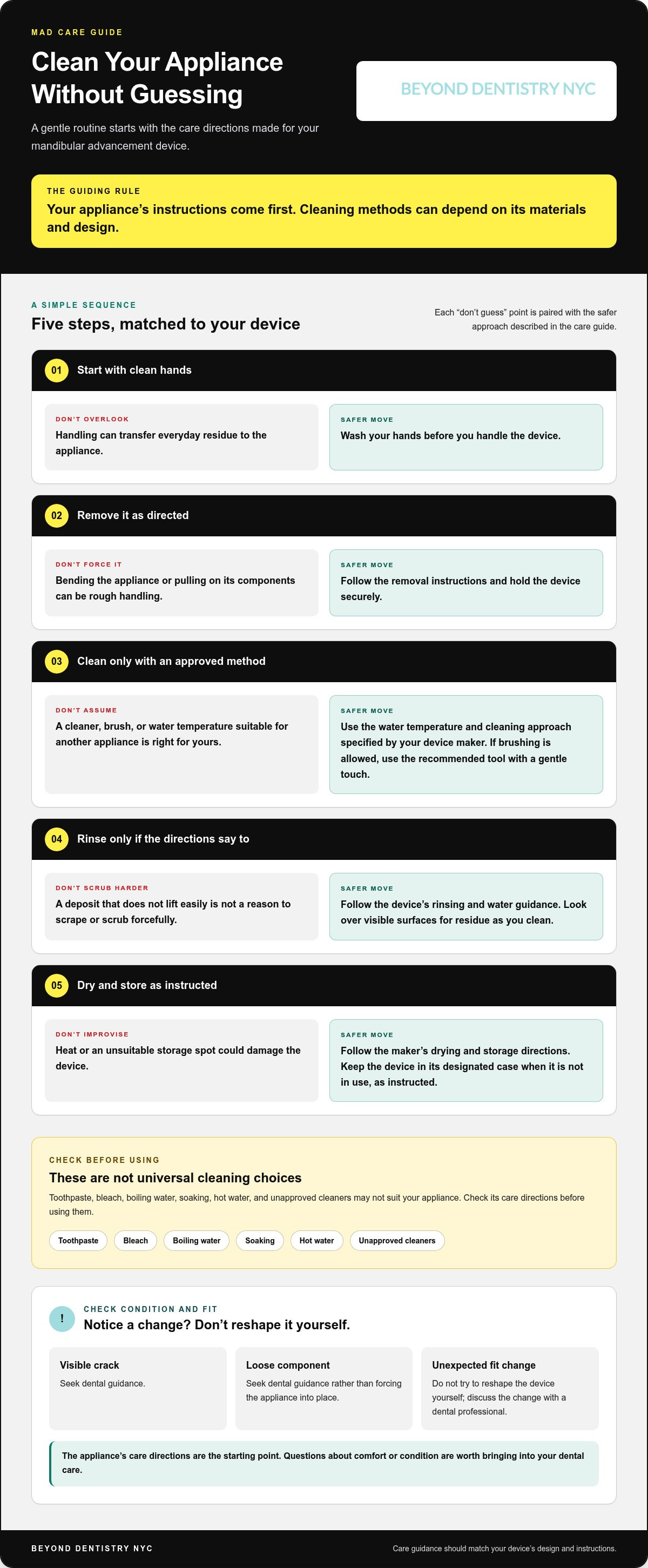
Keep the sequence simple: handle the device carefully, use only an approved cleaning method, and follow its storage directions afterward. Clean hands are a sensible starting point. Do not assume the same cleaning method is right for every MAD.
- Wash your hands. Start with clean hands to avoid transferring everyday residue while handling the appliance.
- Remove the device as directed. Follow the instructions for taking it out. Hold it securely without bending it or pulling on its components.
- Clean with an approved method. Use only the water temperature and cleaning approach specified for your device. If brushing is allowed, use the tool recommended by the maker and a gentle touch. Do not add a cleanser or brush simply because it is commonly suggested for other appliances.
- Rinse only if directed. Follow the appliance’s instructions for rinsing, including the water guidance. Look over visible surfaces for residue as you clean. Do not scrape or scrub forcefully if a deposit does not lift easily.
- Dry or store as instructed. Follow the maker’s directions after cleaning. Some appliances have specific drying or storage guidance, so do not improvise with heat or leave the device somewhere it could be damaged.
In short: handle it gently, clean it only as approved, rinse if directed, then dry or store it according to its instructions.
Keeping your hands and storage case clean
Clean hands help limit the transfer of everyday residue to the appliance. The case matters, too: clean it according to its own care directions rather than assuming the appliance’s cleaning method also applies to the case. When the device is not in use, keep it in its designated case as instructed. This gives you a consistent place to store it between uses.
If you are unsure how a particular step applies to your device, do not guess or combine cleaning methods. The appliance’s design and your experience should inform practical care guidance, especially if you are concerned about handling it or preserving its fit. Beyond Dentistry NYC provides sleep apnea appliances and dental guidance for patients in New York. Learn about appliance care as part of your dental care.
Which MAD cleaning methods are safe, and which should you avoid?
A cleaning method that works for one mandibular advancement device may not suit another. Materials and components differ, so the maker’s care instructions should guide every choice, from cleanser to water temperature. Use the comparison below to identify what to verify, not as approval to try a method on your appliance.
| Method | What it may help with | Instruction to check first |
|---|---|---|
| Water and a soft cloth | Removing visible surface residue | Confirm the permitted water temperature and whether cloth use is recommended. |
| Brushing | Cleaning accessible surfaces or areas with residue | Check whether brushing is allowed and which tool to use; avoid forceful scrubbing. |
| Denture-cleaning tablets | Cleaning through a soaking solution, if approved | Use only if the appliance instructions permit that type of cleanser and soaking. |
| Ultrasonic or ultraviolet equipment | Cleaning with a device, depending on the method and appliance | Confirm that the manufacturer allows the specific equipment for your device. |
| Toothpaste, bleach, or household cleaners | No universal role in MAD care | Do not use unless the instructions explicitly approve the product. |
| Boiling water or unapproved soaking | No universal role in MAD care | Check the permitted temperature and whether immersion is allowed. |
Can you use toothpaste, denture tablets, or household cleaners?
Toothpaste may seem convenient, but its abrasives can scratch some appliances, and a scratched surface may be harder to keep clean. Denture tablets are not automatically suitable for a MAD. Use them only if the device instructions allow that cleanser and method. Avoid bleach and household cleaners unless explicitly approved for your appliance. A product being familiar does not make it appropriate for every device.
Are hot water and ultrasonic cleaners suitable for every MAD?
No single rule covers every appliance. Heat can affect some materials or alter a device’s shape, so do not use boiling or hot water unless the maker’s instructions specifically permit that temperature. Recommendations for ultrasonic and ultraviolet devices also vary. Before soaking or using equipment, check the instructions for your exact appliance rather than relying on advice for another model.
The safest approach to cleaning a mandibular advancement device is to match the cleaning method to the device, not to choose the strongest or most elaborate option. If the instructions do not clearly address a product or piece of equipment, pause before using it. Beyond Dentistry NYC provides sleep apnea appliances and dental guidance that takes the device’s design and the wearer’s experience into account. This can help address care questions without risking an avoidable change to the appliance.
How to store your MAD and spot problems early
Good storage helps protect your appliance between uses, while a quick visual check can help you notice when a concern goes beyond routine care. Follow the maker’s storage directions because drying or ventilation guidance may vary. If you see damage or the device feels different, do not try to fix or adjust it yourself. A dental professional can help determine whether it needs attention.
Where should you keep a mandibular advancement device?
Use the designated clean case and follow the appliance’s instructions about drying or ventilation before storing it. Choose a place away from heat and direct sunlight where the device will not be crushed. Avoid leaving it loose on a bedside surface or in a bag or pocket, where it could be knocked, bent, or damaged. Keep the case clean according to its own care directions.
As part of cleaning a mandibular advancement device, take a moment to look at the visible surfaces. Do not pull at components or try to test their strength. A simple check can help distinguish ordinary residue from a change that deserves professional guidance.
Quick check: routine observation or reason to ask for help?
- Routine observation: You notice surface residue during cleaning and it comes away using the approved method.
- Ask for guidance: You see a crack, a component appears loose, or the device has a new or worsening change in fit.
- Ask for guidance: Odor or residue persists despite following the appliance’s approved cleaning instructions.
When should you ask about fit, damage, or persistent odor?
A new or worsening fit concern is worth raising with your dental team, even if the appliance looks unchanged. Visible cracks or loose components also merit guidance. Do not glue, bend, file, or otherwise attempt an unapproved repair. If odor or residue remains after the recommended cleaning method, do not switch to harsher products or scrub harder. The device’s design and your experience can help inform appropriate next steps.
A change in fit does not automatically tell you what is wrong, but it is useful information to share. Note what you have observed, such as where the appliance feels different or whether a component appears loose. If a concern arises, get advice before making adjustments or continuing to use a device that seems damaged. This keeps the focus on your individual appliance rather than guesswork based on general care tips.
If you have questions about an appliance’s condition or fit, discuss your sleep apnea appliance with Beyond Dentistry NYC for dental guidance.
How dental guidance supports safe care for your sleep apnea appliance
Your appliance’s care instructions are the best starting point, but questions can come up as you use it. Is a cleaning product suitable? Does a change in comfort point to a fit concern? Dental guidance can help connect those observations with your specific device and experience, rather than relying on general advice that may not apply to every appliance.
Why custom appliance guidance matters
Mandibular advancement devices can differ in materials and construction, so recommended cleaning methods may differ, too. Keep the instructions supplied with your appliance and refer to them before changing products or techniques. If a step is unclear, discuss it with your dental team. Guidance that takes the device’s design into account can help you choose a care routine without assuming one method suits every wearer.
An individual approach matters beyond cleaning. If the appliance’s fit or comfort changes, mention what you have noticed and when it began. A change does not automatically explain what is happening, but it gives your dental team useful context. Avoid trying to adjust the device yourself or using a stronger cleaning method to solve a concern that may not be related to cleaning.
Connect daily care with your sleep apnea treatment plan
Cleaning is one practical part of caring for an oral appliance, not a treatment on its own. Use the device as directed within your prescribed sleep apnea plan, and bring questions about its care, fit, or comfort into your follow-up conversations. This keeps appliance care connected to your ongoing needs rather than treating cleaning as a substitute for personalized guidance.
If you are learning about the wider context of sleep apnea care, myofunctional therapy for sleep apnea offers another perspective on treatment approaches. It does not replace the care directions for your MAD, but it can help you explore how different aspects of care may fit into a broader discussion with your dental team.
Questions about cleaning a mandibular advancement device are worth raising if the instructions do not address your concern or if you notice a change in fit, comfort, or condition. Beyond Dentistry NYC provides sleep apnea appliances and dental guidance for patients in New York, with attention to the individual device and wearer. Learn more about sleep apnea appliances at Beyond Dentistry NYC.
Make appliance care part of a confident routine
The most useful routine is one you can follow consistently without second-guessing each step. Keep your appliance’s care instructions somewhere easy to find, and refer to them whenever you are unsure about a product or method. If a question comes up, jot it down along with any change you have noticed in comfort or fit. That gives you a clear starting point for a conversation with your dental team.
Cleaning a mandibular advancement device is one small part of a broader approach to sleep apnea care. Personalized guidance can help you feel more settled about how your appliance fits into your needs, especially if your experience changes over time. You do not have to sort through conflicting advice alone.
Beyond Dentistry NYC brings a thoughtful focus to functional dentistry and advanced clinical care. Explore sleep apnea appliance care with Beyond Dentistry NYC for guidance on your device and fit.
Frequently Asked Questions
How often should you clean a mandibular advancement device?
Follow the cleaning schedule provided with your appliance. If its instructions call for cleaning after each use, make that part of taking it out in the morning. If they give a different schedule, use that instead. Consistency helps prevent residue from lingering between uses. Keep the instructions nearby so you can refer to them if your routine changes or you are unsure whether an extra cleaning step is appropriate.
Can I use toothpaste to clean my mandibular advancement device?
Do not assume toothpaste is safe for your device. Its abrasive ingredients may scratch some appliances, so use it only if the instructions for your specific MAD explicitly allow it. If you have already brushed the appliance with toothpaste, do not scrub harder to remove any marks. Return to the approved cleaning method, and seek individualized guidance if you notice a change in the surface or fit.
Can I soak a mandibular advancement device in denture cleaner?
Only soak your appliance in denture cleaner if its care instructions approve both that product type and soaking. A cleanser intended for dentures is not automatically suitable for every MAD, and the allowed immersion method may depend on the appliance. Check the directions before placing it in a solution. If they do not address denture cleaner, avoid experimenting and ask your dental team for advice specific to your device.
Is it safe to clean a MAD with an ultrasonic cleaner?
Not for every appliance. Ultrasonic cleaning recommendations can vary with the MAD’s materials and construction, so check the manufacturer’s instructions for your exact device before using one. Do not assume an ultrasonic cleaner is suitable just because it is marketed for oral appliances or another wearer uses it. If you cannot find clear instructions, stick with the cleaning method already approved for your device until you get guidance.
What happens if hot water changes the shape of my oral appliance?
If you suspect heat has changed the appliance’s shape, do not try to bend it back or force it into place. A shape change may affect how it fits, so seek advice from your dental team about what to do next. Explain what happened and when you noticed the change. Avoid further heat exposure, and do not resume using an appliance that feels uncomfortable without getting guidance.
How should I store my mandibular advancement device during the day?
Store it in its designated case and follow the appliance’s directions about drying or ventilation before closing the case. If you take it with you, avoid keeping it loose in a pocket or bag where it could be crushed. Choose a location away from heat and direct sunlight, and keep the case clean according to its own instructions. This gives the device a consistent place between uses.
What should I do if my mandibular advancement device no longer fits comfortably?
Tell your dental team about a new or worsening fit concern rather than trying to adjust the appliance yourself. Describe what feels different, such as pressure in a new area or difficulty seating the device, and mention any visible damage. For New York readers, bringing the appliance and its care instructions to a dental follow-up can help make the conversation specific. Do not force a device that feels uncomfortable into place.


