

What if the key to a quiet night and a refreshed morning wasn't a bulky machine, but a series of simple movements designed to strengthen the muscles you use every day? You're likely exhausted by the cycle of restless nights and the clunky reality of a CPAP machine. It's frustrating to wake up feeling like you haven't slept at all, but myofunctional therapy for sleep apnea offers a natural, non-invasive path to reclaiming your energy and protecting your long-term health.
There's a different way to breathe. At Beyond Dentistry NYC, our airway-focused approach integrates this innovative therapy into a comprehensive plan for functional wellness right here in Manhattan. We believe that professional clinical excellence should always feel personal and supportive. By focusing on the root cause of airway collapse, we help you move toward a future defined by comfort and ease rather than clinical struggle.
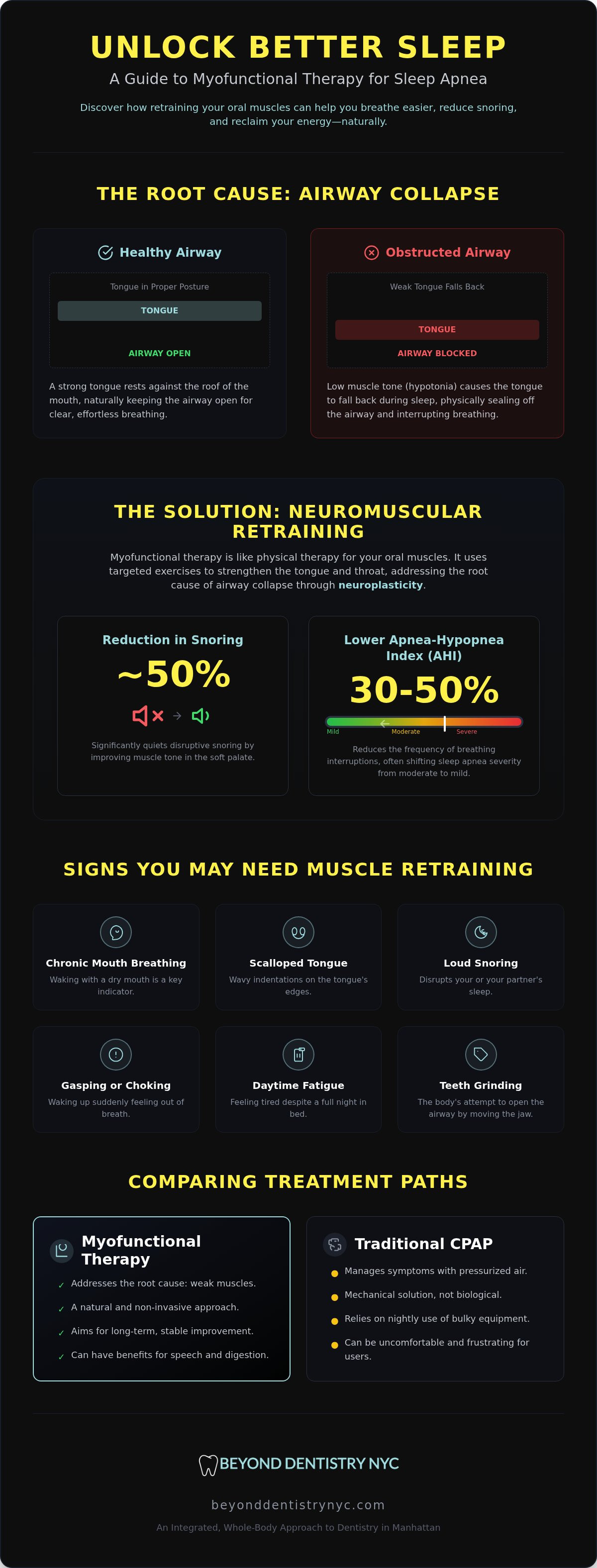
In this guide, you'll discover how retraining your tongue and facial muscles can reduce snoring by approximately 50% and lower the apnea-hypopnea index by 30-50% in adults. We'll walk you through the science of neuromuscular re-education and show you how these targeted exercises provide a clear path to deeper, uninterrupted sleep and a more vibrant life.
Key Takeaways
- Understand how low muscle tone in the tongue and throat contributes to airway collapse and chronic daytime fatigue.
- Learn how myofunctional therapy for sleep apnea leverages neuroplasticity to retrain your muscles for a naturally stable airway.
- Compare the long-term benefits of oral muscle exercises against traditional treatments like CPAP machines and sleep apnea appliances.
- Discover the essential steps of a functional airway evaluation, including how to identify common issues like tongue ties and mouth breathing.
- Explore how an integrated, whole-body approach to dentistry in Manhattan can help you achieve deeper sleep and restored vitality.
What is Myofunctional Therapy for Sleep Apnea?
Think of your mouth and throat as a complex system of muscles rather than just a passage for air. Myofunctional therapy for sleep apnea is essentially physical therapy for the face, mouth, and tongue. While many traditional treatments focus on forcing air through a narrow space, functional dentistry looks at why that space is narrow in the first place. Often, the culprit is low muscle tone, a condition known as hypotonia. When these muscles are "floppy," they simply cannot maintain the structure needed for clear, effortless breathing during the night.
Sleep apnea is frequently treated as a mechanical failure that requires a mechanical solution, such as a CPAP machine. However, at Beyond Dentistry NYC, we view the airway as a dynamic muscular system. If the muscles responsible for keeping your airway open are weak or poorly coordinated, the system fails. By retraining these tissues, we address the root cause of the collapse rather than just managing the symptoms with a mask. It's a forward-thinking approach that prioritizes your comfort and long-term health.
The Role of the Tongue in Airway Health
Your tongue is the most influential muscle in your airway. Its proper "resting posture" is suctioned firmly against the roof of the mouth, which naturally keeps the back of the throat open. When the tongue is weak, it rests low in the mouth or pushes against the teeth. During sleep, gravity takes over and this heavy muscle slides backward. This movement physically seals off your breath, leading to the interruptions that define obstructive sleep apnea. The goal of myofunctional therapy for sleep apnea is to build the endurance and coordination necessary for the tongue to maintain its proper home against the palate, even when you're in a deep sleep.
Symptoms That Suggest a Need for Muscle Retraining
Identifying the need for muscle retraining often starts with observing daily habits that feel "normal" but indicate underlying dysfunction. Chronic mouth breathing is a primary indicator. If you wake up with a dry mouth or feel parched throughout the day, your body is likely bypassing its natural nasal filtration system. You might also notice a "scalloped tongue," where the edges of your tongue show wavy indentations from pressing against your teeth. Other common signs include:
- Loud, disruptive snoring that affects your partner's sleep.
- Waking up gasping or feeling like you're choking.
- Persistent daytime fatigue despite spending eight hours in bed.
- Clenching or grinding your teeth, which often happens as the body tries to move the jaw forward to open the airway.
Our Manhattan team focuses on these functional clues to create a personalized plan that moves you away from anxiety and toward a life of restored energy. By addressing these symptoms through muscle re-education, we help you achieve a more stable airway without the constant frustration of bulky equipment.
The Science: How Oral Exercises Rewire Your Airway
Can you actually change how your brain controls your throat? Yes. It's called neuroplasticity. Myofunctional therapy for sleep apnea isn't just about raw strength; it's about rewiring the neural pathways that govern your airway. When you perform consistent, repetitive movements, you're teaching your brain to maintain a different muscle tone even while you're unconscious. This shift is powerful. Research indicates that these exercises can reduce the Apnea-Hypopnea Index (AHI) by 30% to 50% in adults. This means a shift from moderate to mild severity for many patients, simply by changing the "programming" of their oral muscles. It's a natural way to regain control over your vitality.
Oropharyngeal exercises are targeted movements to improve the tone of the throat and soft palate.
Improving Oropharyngeal Muscle Tone
In functional dentistry, we focus on the structural integrity of the airway. Most sleep apnea occurs because the soft tissues of the throat are too relaxed or "floppy." Through specific training, we can essentially "stiffen" the airway walls. This increased tension prevents the soft palate from collapsing into the throat when you inhale. It's a proactive way to stabilize your breathing without relying solely on external air pressure. Consistent practice helps transform these once-weak tissues into a firm, reliable structure that remains open throughout the night.
Benefits Beyond Sleep: Speech and Digestion
The rewards of this therapy extend well into your waking hours. Many patients unknowingly struggle with poor swallowing patterns that lead to aerophagia, or swallowing air, which causes bloating and digestive discomfort. By correcting these patterns, you improve your digestion and even your speech clarity. There's also an aesthetic component to consider. Better facial muscle tone often leads to more defined jawline definition and reduced tension in the jaw joints. If you're tired of dealing with jaw pain or TMD, retraining these muscles can offer significant relief by balancing the forces in your mouth. This holistic approach ensures that your progress isn't just measured by a sleep study, but by how you feel every single day.
Comparing Treatment Paths: Therapy vs. CPAP vs. Appliances
Choosing the right path for sleep apnea treatment often feels like a trade-off between immediate relief and long-term sustainability. While Continuous Positive Airway Pressure (CPAP) has been a traditional standard, it isn't the only way to reclaim your nights. For many, myofunctional therapy for sleep apnea offers a more natural alternative or a powerful partner to traditional methods. Understanding how these options differ allows you to choose a treatment that fits your lifestyle and your specific health needs.
Why CPAP Compliance is a Challenge
CPAP machines provide immediate airway support by using pressurized air to keep the throat open. However, for many high-performing professionals in Manhattan, the reality of wearing a mask every night is less than ideal. Compliance rates are often low because the machines can be loud, bulky, and socially restrictive. Many patients find the sensation of forced air causes anxiety or physical discomfort. Ultimately, a CPAP is a "band-aid" solution; it manages the symptoms without addressing why the airway is collapsing. This is a core reason why we emphasize What is Functional Dentistry? at our practice. We look for rehabilitative solutions that help the body function correctly on its own.
When to Use a Sleep Apnea Appliance
Sleep apnea appliances offer a more portable and discreet option, particularly for those with mild-to-moderate obstructive sleep apnea. These custom-made devices work by gently holding the lower jaw in a forward position, which prevents the tongue and soft tissues from falling back into the airway. At Beyond Dentistry NYC, we utilize innovative technology to design appliances that are both comfortable and precise. Think of an appliance as a structural fix. It holds the "room" open while you sleep, making it an excellent choice for frequent travelers or those who cannot tolerate a CPAP mask.
The most effective results often come from a combination approach. While an appliance provides the necessary structural support, myofunctional therapy for sleep apnea provides the muscular training. By strengthening the tissues while using a supportive device, you address both the immediate need for oxygen and the long-term goal of airway stability. This dual strategy helps many patients move away from a lifelong dependency on machines and toward a more natural, self-sustaining way of breathing. It's about giving your body the tools it needs to protect itself, ensuring your sleep is as deep and restorative as possible.
What to Expect: The Journey to Better Sleep
Embarking on a path to better breathing is a commitment to your long-term vitality. At Beyond Dentistry NYC, we guide you through a structured process that transforms your breathing from the inside out. This isn't a one-size-fits-all approach; it's a precise, rehabilitative journey designed to address your unique anatomy and habits. By the time you complete your program, your oral muscles will have the strength and coordination to keep your airway naturally open. The process follows five clear steps:
- Step 1: The Evaluation. We begin with a comprehensive airway and functional dental evaluation in our Manhattan office to map your current muscle function.
- Step 2: Identifying Dysfunctions. We pinpoint specific issues, such as a tongue tie or a habit of chronic mouth breathing, that contribute to airway collapse.
- Step 3: The Custom Plan. You receive a tailored exercise plan focused specifically on your muscle weaknesses.
- Step 4: Consistent Practice. Success relies on short, focused sessions. Most patients spend just 5 to 10 minutes twice a day on their exercises.
- Step 5: Monitoring and Adjustment. We track your progress regularly, adjusting the intensity of the retraining as your muscle tone improves.
If you're ready to move beyond the frustration of poor sleep, you can request your functional airway evaluation to begin this transformative process.
Sample Myofunctional Therapy Exercises
The exercises used in myofunctional therapy for sleep apnea are simple but powerful. One common movement is the "Tongue Press," where you push the entire surface of your tongue firmly against the roof of your mouth to strengthen the tongue's base. Lip seal exercises are also vital; these help you transition from mouth breathing to healthy, consistent nasal breathing. To target snoring specifically, we often use soft palate lifts. These movements reduce the "floppiness" of the tissues at the back of your throat, significantly decreasing the vibrations that cause disruptive noise at night.
The Timeline for Results
Patience is essential because muscle memory doesn't change overnight. A comprehensive program typically spans 6 to 12 months, allowing your brain and muscles to fully integrate these new patterns. However, many patients experience "early wins" within the first few weeks. You might notice you're snoring less or feeling significantly more alert upon waking. The ultimate goal of myofunctional therapy for sleep apnea is sustainable airway stability. Over time, this strength reduces your reliance on machines and provides a natural foundation for deep, restorative sleep that lasts a lifetime.
Airway-Focused Care at Beyond Dentistry NYC
Located in the heart of Manhattan, Beyond Dentistry NYC is more than a dental office; it's a sanctuary for those seeking a deeper connection between their oral health and total-body vitality. We understand that living with sleep apnea is exhausting, and finding a solution shouldn't be. Our approach to myofunctional therapy for sleep apnea is rooted in the philosophy of functional dentistry, which treats the airway as a dynamic system rather than a series of isolated parts. We believe that professional clinical excellence should always be paired with a warm, family-oriented atmosphere that makes you feel seen and supported.
Our practice utilizes innovative technology to move beyond traditional guesswork. By providing precise diagnostics, we respect your time and your need for clarity. We don't just look at your teeth; we look at how your tongue, jaw, and throat muscles work together to facilitate every breath you take. This comprehensive view allows us to create a high-end experience that focuses on the root causes of your sleep struggles, helping you transition from a state of chronic fatigue to one of restored energy.
A Compassionate Approach to Sleep Health
Many of our patients arrive feeling frustrated by years of fragmented care or the cold, sterile atmosphere of traditional clinics. We prioritize clear communication and expert guidance to alleviate the anxiety often associated with sleep-disordered breathing. By focusing on ease and positive outcomes, we ensure your journey is as comfortable as the results we aim to achieve. Whether you're visiting us for airway support or looking to enhance your confidence through Smile Gallery Restorations, our commitment to clinical excellence remains the same. We speak your language, avoiding dense jargon in favor of words that evoke quality and emotional satisfaction.
Schedule Your Airway Consultation in Manhattan
Taking the first step toward restorative sleep is a decision that impacts every facet of your life, from your cognitive clarity to your cardiovascular health. During your first visit, Dr. Morgan or Dr. Michael Herman will conduct a thorough assessment of your airway, jaw function, and muscle tone. This isn't just a check-up; it's a collaborative session where we listen to your experiences and design a path forward. We invite you to move beyond the impersonal world of standard medicine and join a practice where your individual success is our primary focus. Let's work together to unlock the deep, uninterrupted sleep you deserve.
Reclaim Your Rest and Vitality
Restoring your sleep isn't just about managing a condition; it's about reclaiming the energy you need to thrive in your daily life. You've seen how myofunctional therapy for sleep apnea addresses the root muscular causes of airway collapse, offering a path to deeper rest without the constant burden of a machine. By focusing on the strength and coordination of your tongue and throat, you're investing in a long-term solution that supports your whole-body health and functional wellness.
At Beyond Dentistry NYC, Dr. Morgan and Dr. Michael Herman lead our Manhattan practice with a commitment to clinical excellence and compassionate care. We utilize innovative technology to provide personalized airway solutions that fit your lifestyle and alleviate the anxiety of poor breathing. Ready to take the first step toward a quieter night and a more vibrant morning? Schedule your functional sleep consultation at Beyond Dentistry NYC today. You don't have to settle for chronic fatigue when a natural, effective path to better breathing is within reach.
Frequently Asked Questions
Is myofunctional therapy as effective as CPAP for sleep apnea?
Myofunctional therapy for sleep apnea is highly effective for mild to moderate cases, often reducing the apnea-hypopnea index by 30% to 50%. While CPAP provides immediate mechanical airway support, therapy focuses on the underlying muscular causes of airway collapse. For many patients in New York, we recommend a combined approach. Strengthening the oropharyngeal muscles can improve the success of other treatments or, in some instances, provide a natural alternative to bulky machines.
How long does it take to see results from myofunctional therapy?
Patients usually begin to notice early wins, such as reduced snoring or improved daytime alertness, within the first few weeks of consistent practice. However, a comprehensive program typically lasts between 6 and 12 months. This duration allows for the full integration of new muscle memory and neural pathways. Like any form of physical therapy, the timeline depends on your commitment to the 5 to 10-minute daily exercise sessions we prescribe during your Manhattan consultation.
Can tongue exercises really stop snoring?
Targeted tongue and throat exercises can significantly reduce or even stop snoring by addressing tissue floppiness. Snoring occurs when air vibrates against relaxed tissues in the airway. By strengthening the tongue's base and the soft palate, you create a firmer, more stable structure that is less likely to vibrate or collapse. Many of our patients report a 50% reduction in snoring intensity after beginning a structured myofunctional program designed to improve airway tone and stability.
Do I need a referral for myofunctional therapy in NYC?
You don't need a formal medical referral to begin your journey at Beyond Dentistry NYC. Many of our Manhattan patients reach out directly after noticing symptoms like chronic fatigue, loud snoring, or mouth breathing. We start with a comprehensive functional evaluation to determine if your issues stem from muscle weakness or structural concerns. Our team will guide you through the process, ensuring you receive the personalized care and innovative technology treatments necessary for your specific needs.
Can children benefit from myofunctional therapy for sleep issues?
Children can benefit immensely from early intervention with myofunctional therapy. Retraining oral muscles during development helps ensure proper jaw growth and healthy nasal breathing patterns. This proactive approach can prevent more severe sleep-disordered breathing issues later in life. At our New York practice, we focus on making these exercises engaging for younger patients, helping them achieve better sleep and improved focus by addressing the root causes of their nighttime breathing struggles rather than just the symptoms.
What happens if I stop doing the exercises?
Consistency is the foundation of muscle memory. If you stop the exercises before the neural pathways are fully established, your muscles may eventually return to their previous, floppy state. Think of it like any other fitness routine; once you reach your goals, a reduced maintenance schedule is often required to keep the airway stable. We monitor your progress closely to ensure your muscles remain strong enough to support effortless breathing without the need for constant, high-intensity training.
Is myofunctional therapy covered by dental insurance?
Coverage for myofunctional therapy for sleep apnea varies significantly between plans. While it's often not covered under standard dental insurance, some medical insurance providers may offer reimbursement if the therapy is deemed medically necessary for a diagnosed condition. Beyond Dentistry NYC does not offer in-house insurance plans, but we can provide the necessary documentation for you to submit to your provider. Many patients also successfully use HSA or FSA funds to cover these restorative health expenses.
How do I know if my sleep apnea is caused by weak muscles?
Several physical signs can indicate that weak muscle tone is contributing to your breathing issues. During a visit to our Manhattan office, we look for indicators like a scalloped tongue, chronic mouth breathing, or a tongue that rests low in the mouth rather than against the palate. If you find yourself gasping for air or waking up with a dry mouth, these are strong signals that your oropharyngeal muscles aren't maintaining a clear airway during sleep.


