

What should you budget for when considering the mandibular advancement device cost NYC patients may face? The appliance is only one part of the picture. Fitting, evaluation, follow-up care, and how your insurance plan handles claims can all affect your individual estimate.
This guide explains what may shape treatment costs, how to prepare insurance and billing questions, and what to compare when weighing an oral appliance against other sleep apnea treatments. A confirmed diagnosis and coordination with your medical team matter when considering an appliance. At Beyond Dentistry NYC, Drs. Morgan and Michael Herman provide sleep apnea appliances using innovative treatment technology. Use the questions below to discuss your needs, care plan, and financial responsibilities with greater clarity.
Key Takeaways
- The mandibular advancement device cost nyc patients may face depends on the evaluation, appliance, and ongoing care involved. One figure may not reflect the full estimate.
- Compare a MAD and CPAP by how each works and fits your needs, not by price alone. Suitability is a clinician-guided decision.
- Review your individual insurance benefits and documentation requirements to understand potential coverage and out-of-pocket responsibility.
- Ask specific questions about the treatment plan, billing, and follow-up care before deciding.
- Beyond Dentistry NYC provides sleep apnea appliances and uses innovative treatment technology as part of its clinical care.
Why mandibular advancement device cost in NYC varies by patient
It’s reasonable to want a clear estimate before choosing sleep apnea treatment. But the mandibular advancement device cost NYC patients may face isn’t always represented by one advertised figure. An estimate may include more than the appliance, and your final out-of-pocket responsibility depends on the care involved and how your benefits apply.
What does a mandibular advancement device do?
A mandibular advancement device, or MAD, is an oral appliance worn during sleep that positions the lower jaw forward. This positioning may help keep the airway open for some people with sleep-related breathing disorders. The mandibular advancement splint overview offers additional background on how these appliances are used.
A MAD isn’t the same as an ordinary night guard. A night guard is generally used to protect teeth, while a sleep apnea appliance is intended to support treatment by repositioning the jaw. Whether an oral appliance is appropriate depends on individual assessment and coordination with sleep apnea care.
Why is there no universal NYC price?
Patients have different clinical needs and care plans, so estimates may cover different services. Appliance design, evaluation, fitting, and follow-up care can all affect what’s included. One advertised amount may refer to the appliance alone, while another may include professional care around its use.
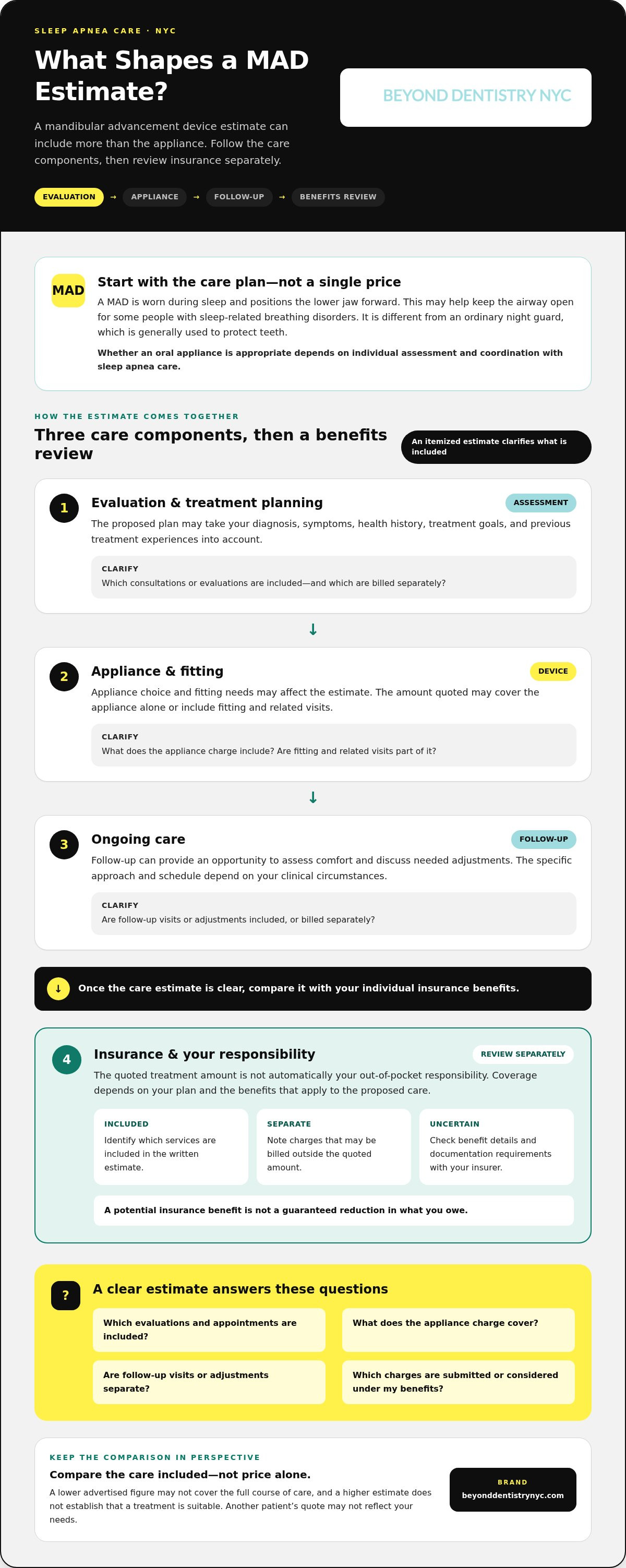
When reviewing an estimate, sort potential charges into three categories:
- Evaluation: Clarify which assessments or appointments are included and whether any are billed separately.
- Appliance: Ask what the quoted amount covers, including the appliance and fitting.
- Ongoing care: Find out whether follow-up visits or adjustments are included or billed separately.
Consider insurance separately. A quoted treatment amount isn’t automatically the same as your personal out-of-pocket responsibility. That depends on your plan and the benefits that apply. Compare the written estimate with your insurer’s benefit information to see which services are included, separate, or still uncertain.
Price matters, but it shouldn’t be the only factor in deciding whether a MAD fits your needs. A lower advertised figure may not cover the full course of care, and a higher estimate doesn’t establish that a treatment is suitable. At Beyond Dentistry NYC, patients can discuss sleep apnea appliances with a dental team led by Dr. Morgan Herman and Dr. Michael Herman. A focused discussion can help clarify the care being considered alongside the costs and coverage questions that matter to you.
What factors shape a mandibular advancement device estimate?
A useful estimate explains how the proposed care is put together, not just the appliance charge. For patients considering the mandibular advancement device cost NYC, it helps to separate evaluation, appliance, and ongoing-care costs from insurance benefits and personal responsibility. The details depend on your clinical circumstances, so another patient’s quote may not reflect the care you need.
Clinical evaluation and treatment planning
An oral appliance belongs within a sleep apnea care plan, rather than being treated as a stand-alone purchase. A discussion of your diagnosis, symptoms, health history, and treatment goals can help identify relevant questions and next steps. Sharing previous treatment experiences can also clarify what matters to you, such as comfort, ease of use, or fitting care.
Ask how the estimate addresses these items:
- Assessment and planning: Which consultations or evaluations are part of the proposed plan, and which are billed separately?
- Appliance costs: What is included in the appliance charge, fitting, and related visits?
- Ongoing care: Are follow-up appointments or adjustments included, or are they separate charges?
These categories help organize the discussion. They aren’t a list of services every patient will need. The care team can explain which apply to your treatment plan.
Appliance and follow-up considerations
Appliance choice and fitting needs may affect the estimate. The treatment plan may account for how the appliance is selected and fitted to you. Follow-up care can provide an opportunity to assess comfort and discuss any needed adjustments. The specific approach depends on your clinical circumstances, so don’t assume every patient will have the same appliance or schedule.
An individual estimate can change with the evaluation, appliance and fitting needs, planned follow-up care, and benefits that apply. Ask for an itemized breakdown and note what’s included, what may be billed separately, and what is still being determined. This gives you a practical way to compare the proposed care with your budget without reducing the decision to price alone.
Keep insurance separate in your planning. The estimated treatment charge and your plan’s benefits are different questions. Coverage and your share depend on your individual plan and how it applies to the proposed care. Review your benefits alongside the estimate, and clarify which charges are being submitted or considered under those benefits. A potential benefit shouldn’t be treated as a guaranteed reduction in what you owe.
At Beyond Dentistry NYC, a discussion about sleep apnea appliances can connect your treatment goals with questions about fitting, follow-up, and cost. Bring your diagnosis information, current benefits details, and questions about what each estimate category includes to make the conversation more specific.
MAD versus CPAP: compare treatment fit before comparing costs
A lower price or simpler-sounding routine doesn’t automatically make one sleep apnea treatment the right choice. A mandibular advancement device (MAD) and continuous positive airway pressure (CPAP) work differently. Compare how each may fit your diagnosis and daily life before weighing expenses. The mandibular advancement device cost NYC patients are considering is only one part of the decision.
How oral appliances and CPAP differ
A MAD is worn during sleep and positions the lower jaw forward. CPAP uses a machine to deliver pressurized air through a mask to help keep the airway open. These differences affect the practical experience and ongoing care, but they don’t determine which treatment is suitable for you.
| Comparison | MAD | CPAP |
|---|---|---|
| Treatment format | An oral appliance worn during sleep to reposition the lower jaw. | A machine-based therapy that delivers pressurized air through a mask. |
| Practical considerations | Discuss wearing an appliance, fitting, comfort, and expected follow-up. | Discuss the mask, machine setup, routine of use, comfort, and expected follow-up. |
| Suitability | A clinician can consider whether oral appliance therapy fits your diagnosis and needs. | Your healthcare team can consider whether CPAP fits your diagnosis and needs. |
The table is a starting point, not a treatment recommendation. Neither option is universally best, and personal preference alone can’t establish clinical suitability. Your healthcare team can weigh your diagnosis and health needs alongside the practical realities of each approach.
Questions that make a comparison more useful
Bring specific questions to your care team. Ask how each option relates to your diagnosis, what using it may involve in your daily routine, and what follow-up is expected. Describe any comfort concerns or previous treatment experiences. Those details can make the discussion more relevant to you.
Keep three considerations distinct: clinical appropriateness, day-to-day practicality, and cost. A treatment that seems convenient or affordable still needs to fit the care plan. An initial estimate alone won’t explain the ongoing routine or follow-up associated with an option. Ask what the quoted care includes and how expected follow-up may affect your overall planning.
Related education, such as information about myofunctional therapy for sleep apnea, can help you learn about other approaches discussed in sleep apnea care. Treat it as background for a conversation, not a way to diagnose yourself or replace guidance from your healthcare team. The most useful comparison accounts for your diagnosis, treatment goals, preferences, and the care your team recommends.
How to understand insurance and your out-of-pocket responsibility
Insurance questions can feel like a second treatment decision. Reviewing your benefits can help you understand what your plan says, what documentation may be needed, and which costs could remain your responsibility. Coverage for a sleep apnea appliance depends on your individual plan, clinical documentation, and applicable benefit terms. Another patient’s experience may not predict yours. This matters when estimating the mandibular advancement device cost NYC patients may pay.
A simple sequence for clarifying benefits
Use these steps to organize the conversation. Keep notes, including the date and details of discussions with your insurer, so you can refer back to what you were told.
- Review your plan language. Look for sections about sleep apnea appliances and durable medical equipment. Note any definitions, exclusions, or limits that may apply.
- Ask about plan-specific requirements. Contact your insurer to ask what clinical documentation is needed and whether pre-authorization applies. If the insurer uses unfamiliar terms, request an explanation in writing.
- Clarify the estimate. Ask for a written explanation of the estimated patient responsibility before making financial assumptions. Find out which treatment items it covers and whether the insurer’s information is preliminary or based on a review of submitted documentation.
Keep three stages distinct. Pre-authorization, if required, is a review before treatment, not a guarantee of payment. Approval or benefit determination reflects how the plan processes the specific request under its terms. Reimbursement and final responsibility concern how a claim is paid or handled and what portion, if any, remains for you. Processes vary by plan, so written benefit information can help clarify what each answer does and doesn’t establish.
What to bring to a cost discussion
Bring current insurance information, relevant plan correspondence, and any written estimate you’ve received. Prepare questions about:
- Which evaluation, appliance, fitting, and follow-up items are included in the estimate?
- What documentation does the insurer request for this plan, and who submits it?
- Does the plan require pre-authorization, and what does its response mean for payment?
- Is reimbursement handled differently from direct claim processing, and what could remain your responsibility?
A broader functional dentistry perspective can help frame care around your health needs, not just one appliance or benefit question. At Beyond Dentistry NYC, a discussion about sleep apnea appliances can connect treatment planning with practical cost and coverage concerns. Bring your questions and plan details to discuss sleep apnea appliance care with the dental team.
Discussing a sleep apnea appliance with Beyond Dentistry NYC
Considering an oral appliance can raise both clinical and practical questions: Could it fit my needs? What care might be involved? How should I plan for the cost? At Beyond Dentistry NYC, patients can discuss sleep apnea appliances with a dental team that uses innovative treatment technology. The conversation considers your circumstances rather than assuming one approach is right for everyone.
What to expect from an individualized conversation
Share what you know about your sleep apnea history, your concerns, and what you hope treatment will address. If you’ve tried another approach or have questions about comfort and daily routines, mention those too. This context can guide a discussion about whether appliance treatment may be worth considering as part of your care.
Prepare a short list of questions, such as:
- What parts of the proposed care relate to evaluation, the appliance, fitting, and follow-up?
- Which elements of the plan are specific to my clinical needs?
- What should I understand about my insurance benefits and possible out-of-pocket responsibility?
- What additional information should I bring to make the discussion more useful?
You don’t need to arrive with every answer. These questions provide a practical starting point. Your care team can discuss appliance treatment and the factors that shape an individual estimate. Insurance benefits and final responsibility remain subject to your plan’s terms. The discussion can help clarify what to resolve, but it can’t promise a particular diagnosis, treatment outcome, coverage decision, or fixed price.
A confident next step for NYC patients
It’s reasonable to consider clinical fit and cost together. Understanding the care being considered, what may be included in an estimate, and what you still need to learn about benefits can make the decision more manageable. Bring relevant sleep apnea information, insurance details, and written questions so you can focus on what matters most to you.
Beyond Dentistry NYC is led by Dr. Morgan Herman and Dr. Michael Herman and provides sleep apnea appliances as part of its clinical care. If you’re weighing the mandibular advancement device cost NYC treatment may involve, bring your questions to the practice. Connect with Beyond Dentistry NYC to discuss sleep apnea appliance care.
Take the next step with confidence
You don’t have to settle every question before starting a conversation. First, identify what you still need to understand, whether that’s how treatment could fit your goals or how to plan for the financial side. Clear answers can help you move forward thoughtfully without feeling pressured to decide before you’re ready.
If you’re weighing mandibular advancement device cost nyc, bring your questions to a conversation focused on your individual needs. Beyond Dentistry NYC provides sleep apnea appliances and uses innovative treatment technology. The New York practice is led by Dr. Morgan Herman and Dr. Michael Herman.
Connect with Beyond Dentistry NYC to discuss sleep apnea appliance care and take a practical first step toward understanding your options.
Frequently Asked Questions
How much does a mandibular advancement device cost in NYC?
There isn’t one price that predicts every patient’s bill. The mandibular advancement device cost nyc patients pay depends on the care plan, services included in the estimate, and benefits applied by their insurer. Compare the written estimate with your plan’s explanation of benefits and note any items that appear in one but not the other. Ask how long the estimate is valid and which amounts are still preliminary.
Does insurance cover a mandibular advancement device for sleep apnea?
Coverage depends on your insurance plan and its requirements, so don’t assume the appliance is covered or that approval removes all patient costs. Ask your insurer what documentation it needs, whether it requires advance review, and how it explains your responsibility. Keep the representative’s response or plan correspondence with your records. The dental team can discuss treatment-related questions, while your insurer provides the plan-specific benefit determination.
Is a mandibular advancement device cheaper than CPAP?
Not necessarily. The full comparison depends on the individual treatment plan, insurance benefits, and costs associated with each therapy. An initial device or equipment estimate may not reflect all expenses over time. Compare written estimates that explain what’s included, and ask which ongoing costs or follow-up may apply. Then discuss clinical suitability with your healthcare team. A lower apparent cost alone doesn’t make either treatment the better choice for you.
Can I get a mandibular advancement device without a sleep apnea diagnosis?
A dental appliance shouldn’t replace an evaluation for possible sleep apnea. If you’re concerned about symptoms, discuss them with an appropriate healthcare professional and ask what assessment makes sense for your situation. Snoring by itself can’t establish whether you have sleep apnea or rule it out. A clinician can consider your health information and help determine whether an oral appliance belongs in a broader care plan.
What should I ask before agreeing to an oral appliance?
Ask for a clear explanation of what the estimate includes, what follow-up may involve, and which parts of the recommendation reflect your clinical information. You can also ask what alternatives may be relevant to your care and how your insurance plan processes the proposed treatment. If a charge or term is unclear, request a plain-language explanation before deciding. Writing down the answers can make the plan easier to review later.
Is a mandibular advancement device the same as a night guard?
No. These appliances have different purposes. A mandibular advancement device is used in sleep-related treatment to position the lower jaw, while an ordinary night guard is not automatically intended to treat sleep apnea. If you already wear a night guard, mention it during your dental discussion. Ask what the appliance is designed to do and how its purpose relates to your individual care plan.
What happens if my insurance does not cover the device?
Ask for an explanation of the estimated patient responsibility and which services or appliance-related items it includes. Then contact your insurer to understand whether your plan has a reimbursement or appeal process and what information it requires. A coverage denial answers a benefits question, not by itself whether treatment is clinically appropriate. Discuss your care choices and the financial options available under your plan before deciding.


