

What if two All-on-4 estimates look very different because they describe different treatment plans? It’s understandable to want a clear answer about the all-on-4 dental implants price new york patients may face, especially when an early quote doesn’t explain what could be included or considered separately. A meaningful estimate should reflect your clinical needs and the care planned from start to finish, not just a headline figure.
This guide explains which factors can shape an estimate and how to discuss its scope with confidence. You’ll learn how evaluation findings, preparatory care, restoration choices, and treatment stages may affect a plan, along with questions that can help clarify what’s included. Because implant planning connects function with restoration, a useful conversation starts with your goals and oral health, not a one-size-fits-all number.
At Beyond Dentistry NYC, Dr. Morgan Herman and Dr. Michael Herman provide dental implant and restorative care with a functional dentistry perspective, supported by innovative clinical technology. Use this guide to prepare for a patient-specific discussion of your options.
Key Takeaways
- The all-on-4 dental implants price new york patients are quoted depends on the treatment plan, so a personalized evaluation matters more than a headline figure.
- Compare estimates by reviewing planned procedures, the final restoration, treatment stages, and follow-up care.
- Look separately at implant-related care and the design and fabrication of the final restoration to understand an estimate’s scope.
- Use your consultation to discuss how your oral health and goals may shape candidacy and treatment planning.
- A functional and restorative perspective can keep the conversation focused on your needs and the care being proposed.
All-on-4 Dental Implants Price in New York: Why There Is No One-Size-Fits-All Estimate
What will All-on-4 treatment cost for you? It’s a fair question, especially when you’re evaluating major restorative care and need to understand what an estimate covers. The phrase all-on-4 dental implants price new york doesn’t point to one universal figure. A responsible estimate reflects clinical findings and the specific care planned for an individual. This guide doesn’t provide a standard New York price or a patient-specific quote. Instead, it explains why estimates vary and what to look for in one.
What does All-on-4 mean in full-arch tooth replacement?
All-on-4 describes a full-arch restoration supported by four dental implants. Implants placed in the jaw support a restoration designed to replace the teeth across an upper or lower arch. That differs from replacing one missing tooth, where an implant may support an individual replacement. For a general overview of how dental implants are placed and integrate with the jaw, see Dental Implant.
The name describes a treatment concept, not a design that suits everyone. The condition of the teeth and supporting structures, overall oral health, and restorative goals all inform the treatment plan. An individual dental assessment is needed to determine whether this approach is appropriate and what care may be involved.
Why can two New York estimates differ?
Two people considering a similar full-arch restoration may have different clinical needs. One plan may involve care beyond implant placement, while another may call for a different restorative design or sequence. The estimate also reflects the planned scope of the final restoration and any other services identified through evaluation. Those details can’t be inferred reliably from a citywide average or another patient’s experience.
Individual estimates reflect clinical needs and planned treatment scope. This matters in New York, where broad market figures can combine different treatment plans, restoration designs, and care components. An average may offer general context, but it can’t show what your examination reveals or what a specific estimate includes. Comparing figures without comparing their scope can leave important differences unclear.
As you review an estimate, focus on how it connects to your proposed plan. Does it describe the full-arch restoration or only part of the care? Are the procedures and stages explained in terms you understand? These questions can help you distinguish a preliminary figure from a plan tailored to your clinical findings, without assuming a particular service applies in every case.
At Beyond Dentistry NYC, dental implant planning is part of a functional and restorative approach to care. Discussing your needs, goals, and proposed treatment scope can make an estimate more meaningful. Start by understanding which parts of the plan may contribute to its overall scope.
What an All-on-4 Treatment Plan May Include, and What Shapes Its Scope
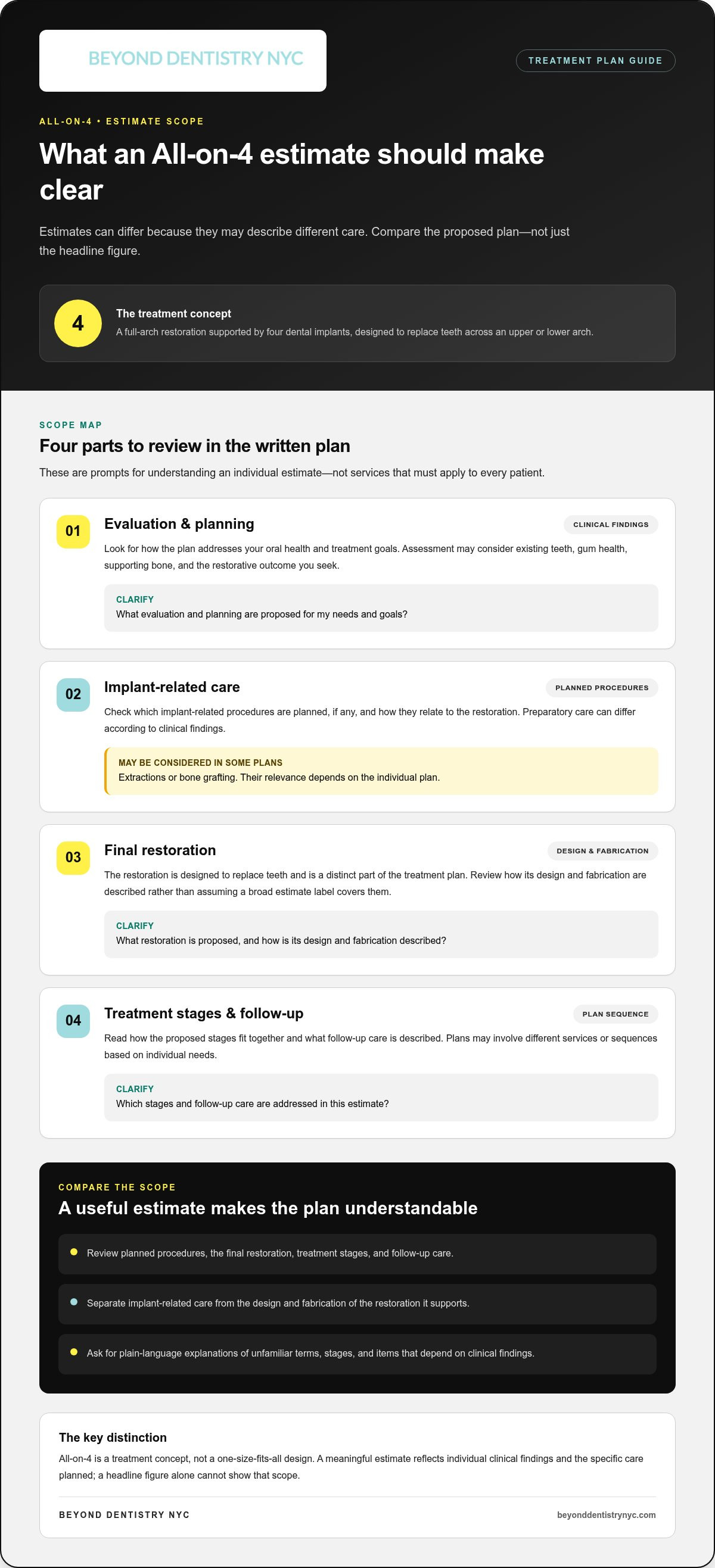
An All-on-4 estimate is easier to understand when you can see how it relates to the proposed care. A plan may involve several parts, from evaluating your oral health and planning implant-related care to designing and fabricating the final restoration. These are general treatment concepts, not a fixed sequence or a promise that every component will apply to every patient.
It helps to distinguish the implant-related care from the restoration it supports. Implant planning addresses the clinical approach for supporting a full arch. The restoration is designed to replace the teeth and is a separate part of the treatment plan. The two are connected, but a written estimate should make their respective scopes understandable rather than leaving you to infer what a broad label includes.
Which parts of care should patients understand in an estimate?
Look for a clear description of the evaluation, planned procedures, restoration, and any follow-up care addressed in the plan. Inclusions vary according to individual clinical needs and the proposed approach. A written explanation gives you something concrete to review and compare, and helps identify questions that still need answers.
Review the plan itself, not just its title. Consider whether it explains:
- What evaluation and planning are proposed for your oral health and treatment goals.
- Which implant-related procedures are planned, if any, and how they relate to the restoration.
- How the final restoration is described, including its design and fabrication as part of the proposed care.
- What follow-up care is described and how it fits into the overall plan.
These points aren’t a checklist of services that must appear in every estimate. They’re prompts for understanding the particular plan in front of you. If a term or stage is unfamiliar, ask for a plain-language explanation. A clear discussion can help you understand what is planned, what depends on clinical findings, and how different parts of care fit together.
How can oral health and restoration needs change the plan?
Planning takes account of more than the number of teeth being replaced. The clinician may assess existing teeth, gum health, supporting bone, and the restorative outcome you’re seeking. These findings help shape the proposed approach. A general description of All-on-4 can’t replace an individual assessment.
For example, extractions or bone grafting may be considered in some implant treatment plans, but they aren’t automatic inclusions. Whether either is appropriate depends on clinical findings and should be explained as part of an individualized recommendation. Don’t assume a procedure is necessary or included in an estimate simply because it appears in a general discussion of implant care.
The treatment plan, not the label alone, defines an estimate’s scope. To make the all-on-4 dental implants price new york discussion more useful, focus on how the proposed care reflects your examination and restorative needs. For a patient-centered conversation about dental implant care, talk with the Beyond Dentistry NYC team.
Comparing All-on-4 Estimates in New York: Look Beyond the Bottom Line
A lower initial figure may look appealing, but it doesn’t necessarily describe the same scope of care as another estimate. One proposal may outline more treatment stages or follow-up than another, or describe the restoration differently. The fairest comparison is between written plans that explain what’s proposed, not between numbers attached to similarly named treatments.
Use the table to compare the details each estimate describes. It isn’t a list of services that every plan must include. The goal is to understand what each estimate covers and where the plans differ.
| Estimate area | What to compare | Question to discuss |
|---|---|---|
| Planned procedures | The procedures described and how they relate to your evaluation and treatment goals. | Which procedures are proposed, and what findings make them part of my plan? |
| Restoration | How the final restoration is described and how it relates to the implant-related care. | What restoration is being planned, and what aspects of its design are outlined? |
| Treatment stages | The sequence of care and what each stage covers. | What care is planned at each stage, and could the plan change as treatment progresses? |
| Follow-up | Any follow-up visits or adjustments described in the proposed plan. | Which follow-up visits or adjustments are included in the plan? |
Which questions make two estimates easier to compare?
Keep the conversation practical and open. Ask how the proposed care connects to your evaluation, how the restoration is described, and what follow-up the plan outlines. If a term or stage is unclear, ask for a plain-language explanation. These questions help you understand the recommendations; they aren’t an accusation or a reason to assume that one clinician’s plan is incomplete.
Review the estimates side by side and mark differences in wording. A variation may reflect a difference in clinical recommendations or simply how the proposed care is described. Ask for clarification before drawing conclusions. For broader context about planning implant care in New York, explore this New York tooth implant patient guide.
How should patients think about insurance and payment?
Insurance benefits and your out-of-pocket responsibility depend on your coverage and plan terms. Review your benefit information for details relevant to the proposed treatment, and clarify how any expected benefit was estimated. Don’t treat an estimate as a promise of reimbursement. Payment arrangements also vary, so focus on the written information for your proposed care rather than assuming a particular option applies.
A clear comparison starts with understanding the proposed care, not choosing the smallest initial figure. To discuss implant and restorative needs in a patient-centered way, you can discuss implant care with Beyond Dentistry NYC. That conversation can put your all-on-4 dental implants price new york estimate into the context of its treatment plan.
Candidacy, Evaluation, and Questions to Discuss Before Choosing All-on-4
An online checklist can’t determine whether All-on-4 is right for you. Candidacy and treatment design depend on an individual dental evaluation, which considers your history, current oral health, goals, and clinical findings together. The assessment helps shape a personalized recommendation; it doesn’t guarantee that one particular procedure will be advised.
What can a patient expect from an implant evaluation?
The conversation may cover your dental history, current concerns, previous care, and what you hope to achieve with a restoration. The clinician can also examine your teeth, gums, and supporting structures. Imaging may be recommended when appropriate to help assess your situation. The evaluation and any imaging depend on your clinical needs.
Prepare a few notes to make the discussion more focused:
- Gather your history. Note relevant dental or medical history, previous treatments, and current concerns you want the clinician to understand.
- Clarify your goals. Think about what matters to you in a restoration, such as function, comfort, appearance, or a combination of priorities.
- Review the findings. Ask the clinician to explain the assessment in clear language and how it relates to the options being discussed.
- Understand the proposed plan. Ask what the recommendation involves, why it fits your situation, and what other considerations may affect the approach.
This is a conversation, not a pass-or-fail test. Clinical factors such as the condition of the supporting bone may be relevant to planning. A dental professional should explain healing and potential risks in the context of your health and proposed care. Avoid drawing conclusions from a brief online quiz or someone else’s experience. Your clinician can explain which findings matter in your case and what they mean for treatment.
What questions help clarify the treatment plan?
Bring questions that connect the clinical recommendation to everyday outcomes. How is the proposed restoration intended to address function, comfort, and appearance? What stages are anticipated, and what might cause the plan to change? What follow-up is described, and how will progress be reviewed? These questions help you understand the reasoning and the care ahead without assuming every treatment follows the same path.
You may also want to understand how oral health and restorative goals are considered together. This broader perspective is part of functional dentistry and can help frame questions about how treatment fits your needs.
A thoughtful evaluation gives context to the all-on-4 dental implants price new york discussion by connecting the estimate to your proposed care. To talk through implant needs and treatment questions with Beyond Dentistry NYC, schedule a conversation about implant care.
Discussing Implant Care and Your Next Steps at Beyond Dentistry NYC
Understanding an estimate is one part of deciding how to move forward. You also need to understand how a proposed restoration relates to your health, everyday function, and personal goals. At Beyond Dentistry NYC, dental implant and restorative care is approached through functional dentistry, with attention to how treatment planning and restoration work together. This keeps the conversation centered on your needs rather than a treatment label alone.
How does restorative planning support an informed decision?
A full-arch restoration is meant to do more than change the appearance of a smile. The discussion can include what you hope to achieve in function, comfort, and appearance, and how those priorities inform the proposed restorative plan. Sharing your goals helps the care team understand what matters to you and explain how the recommendation is shaped around them.
Beyond Dentistry NYC incorporates innovative technology treatments as part of its clinical approach. Technology supports planning, while recommendations remain grounded in your evaluation and restorative needs. The practice is led by Dr. Morgan Herman and Dr. Michael Herman, whose work in implant and restorative care reflects a focus on the individual behind the treatment plan.
If you’re also considering how functional goals and appearance fit together in broader restorative care, the smile reconstruction guide offers additional context. It can help you identify questions to bring to a discussion about your own needs.
What should patients bring to an implant conversation?
You don’t need to arrive with every treatment decision made. A few practical notes can help focus the conversation and give your dental team useful context:
- A current list of medications and relevant health information.
- A brief summary of your dental history, including prior treatment or concerns you’d like to discuss.
- Questions about your goals, the proposed restoration, and what the estimate describes.
- Any concerns about function, comfort, appearance, or the steps involved in care.
It’s reasonable to ask for unfamiliar terms to be explained or to take time to consider the information you receive. A consultation is a chance to discuss your circumstances and understand the recommendation, not a promise of one specific outcome. Your questions can help make the next steps clearer and more personal.
If you’re ready to discuss your individual implant needs and explore a treatment plan tailored to your evaluation, connect with Beyond Dentistry NYC about implant care. A thoughtful conversation can help you approach the all-on-4 dental implants price new york question with greater clarity and confidence.
Take the Next Step With Clarity
Choosing a path for full-arch care doesn’t have to begin with a decision. It can begin with a conversation about what matters to you, what the proposed care is designed to address, and what you need to feel comfortable moving forward. Keep your questions close, take time to consider the answers, and make sure you understand how an estimate connects to the treatment being discussed.
The all-on-4 dental implants price new york question becomes more useful when the discussion focuses on your circumstances rather than a number in isolation. Beyond Dentistry NYC’s implant and restorative care is led by Dr. Morgan Herman and Dr. Michael Herman, with innovative technology treatments and a functional dentistry perspective informing care.
When you’re ready, discuss your dental implant needs with Beyond Dentistry NYC. A focused conversation can help you understand the proposed plan and decide on your next step.
Frequently Asked Questions
How much do All-on-4 dental implants cost in New York?
There isn’t one reliable figure that applies to every patient in New York. The all-on-4 dental implants price new york depends on the care proposed after an individual evaluation, so a general online number can’t serve as your personal quote. For a useful estimate, review the written plan alongside its procedures, restoration, and follow-up. Ask the dental team to explain any terms or parts of the plan that aren’t clear.
What factors can change the price of All-on-4 treatment?
The proposed scope of care is a key factor. Clinical findings, the condition of existing teeth and supporting structures, any recommended preparatory procedures, and the planned restoration can all affect what an estimate describes. Treatment stages and follow-up may also differ by plan. For example, two estimates may use the same treatment label but describe different procedures or restoration details, so compare the descriptions rather than the label alone.
Does an All-on-4 estimate include the final teeth?
An estimate’s wording determines whether it describes the final restoration as part of the proposed care. Look for a clear description of the restoration and how it relates to implant-related procedures. If the wording is broad, ask the dental team to explain what the estimate covers and what is described separately. This helps clarify the overall plan before you make decisions, without assuming every estimate includes the same components.
Does dental insurance cover All-on-4 implants in New York?
Coverage depends on your individual policy and how your insurer evaluates the proposed care. Don’t assume that a benefit applies to every part of treatment or that an estimate guarantees reimbursement. Review your plan documents and contact your insurer with the proposed treatment details to understand applicable benefits and any limits. You can also ask the dental team what information is available to support your coverage inquiry, then compare it with your insurer’s response.
Am I a candidate for All-on-4 dental implants?
Only an individualized dental evaluation can determine whether All-on-4 may suit your situation. A clinician needs to consider your dental history, current oral health, supporting structures, and restoration goals. An online quiz or a friend’s experience can’t establish candidacy. Bring questions about your concerns and desired outcomes to an evaluation, then ask how the findings inform the recommendation and whether other treatment approaches should be discussed.
How long does All-on-4 treatment take from consultation to final restoration?
The overall timeline varies with the individual treatment plan, so there isn’t one duration that applies to everyone. A consultation can clarify the proposed stages and what needs to happen before the final restoration is completed. Ask which steps are anticipated, what factors could affect their sequence, and how progress will be reviewed. A personalized explanation is more useful than a general timeline that may not reflect your clinical needs.
Is All-on-4 treatment painful?
People’s experiences differ, and your dental team is best placed to discuss comfort and what to expect for the care being considered. Before treatment, ask what approach to comfort is planned, what sensations may occur during recovery, and whom to contact with concerns afterward. Sharing anxiety or previous difficult dental experiences is helpful, too. That gives the team context for discussing your concerns and care plan with you.
To discuss your implant needs and review a treatment plan tailored to your evaluation, contact Beyond Dentistry NYC.


