

What if a bite that feels off doesn’t mean your jawbones need to be moved? The answer to how to improve jaw alignment without surgery depends on what’s causing the concern: tooth position, jaw structure, or how the jaw joints and muscles are functioning. These issues can feel similar, but they call for different approaches.
It’s understandable to want relief without surgery and to wonder whether non-surgical care can make a meaningful difference. Some approaches may change how teeth meet or ease certain jaw symptoms, but they can’t necessarily change the position of the jawbones. Knowing the difference can help you set realistic expectations before choosing a treatment.
This article explains the difference between bite alignment, skeletal jaw position, and TMD symptoms, then explores what non-surgical options may address and where their limits lie. You’ll also learn what details to bring to a clinical conversation in New York City. An individualized functional evaluation can help connect your symptoms and bite concerns with an appropriate next step, including care focused on jaw comfort and function.
Key Takeaways
- To understand how to improve jaw alignment without surgery, first identify whether the concern involves tooth position, jaw structure, or joint function.
- Orthodontic appliances can move teeth, but they don’t automatically change an adult’s jawbone structure.
- Non-surgical care may focus on bite changes or symptom relief; it can’t be assumed to reposition the jawbones.
- Prepare for an evaluation by noting your symptoms, when they occur, how they affect daily function, and what concerns you most.
- Beyond Dentistry NYC’s TMD care focuses on jaw symptoms and function, helping frame an individualized care conversation.
What Does Jaw Alignment Mean, and Can It Improve Without Surgery?
Surgery isn’t the only topic to discuss when your bite or jaw feels different. The useful first step is to identify what may be contributing to the concern. If you’re considering how to improve jaw alignment without surgery, separate changes in tooth position from changes in jawbone structure and from care aimed at jaw comfort or movement. These issues can overlap, but improvement in one area doesn’t automatically mean change in another.
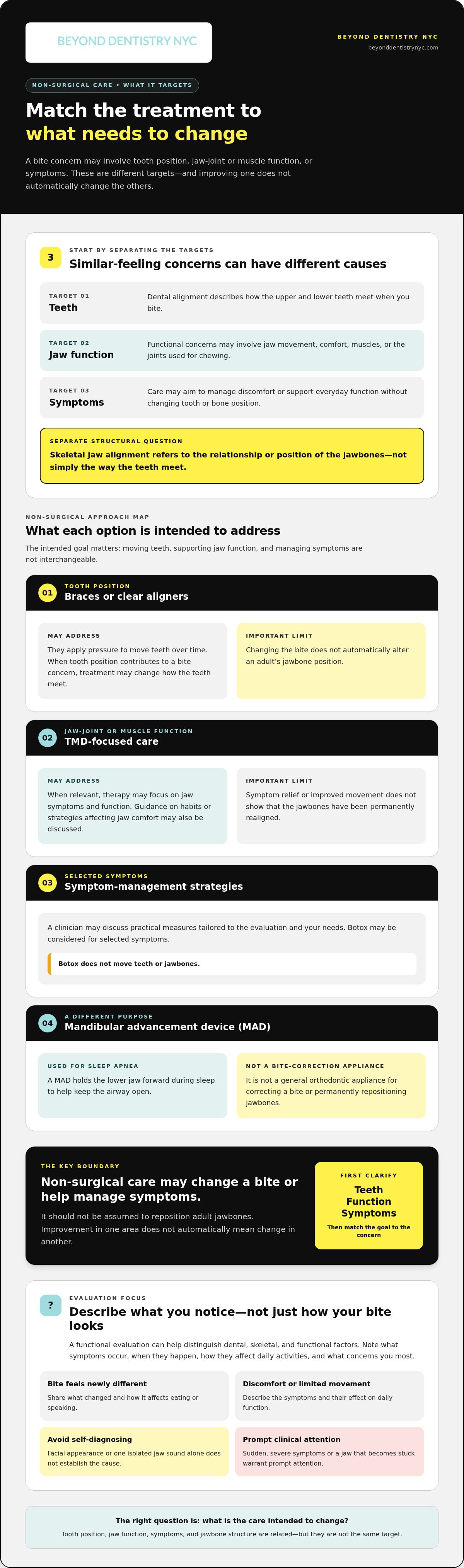
Jaw alignment can refer to how the teeth fit together, how the upper and lower jaws relate, and how the jaw moves at its joints. A dental concern may involve the way teeth meet when biting. A skeletal concern involves the relationship or position of the jawbones. A functional concern may involve movement, comfort, or the muscles and joints used for chewing. An evaluation helps clarify which factors are relevant rather than assuming a single cause.
Dental alignment describes how the teeth meet; skeletal jaw alignment describes the relationship of the jawbones. Improving bite function or easing discomfort may be valuable, but it isn’t the same as repositioning adult jawbones. This distinction helps set realistic expectations for non-surgical care.
How teeth, jawbones, and the jaw joint relate
Occlusion is the way the upper and lower teeth meet when you bite. If that fit changes, the cause may involve tooth position, jaw relationships, or other factors. The Malocclusion overview describes bite patterns that don’t fit together typically, but a label alone doesn’t explain what’s driving an individual’s symptoms.
The temporomandibular joints, often called TMJs, connect the lower jaw to the skull and support movements such as opening, closing, and chewing. Dental, structural, and functional concerns can occur together. For example, you might notice a changed bite along with discomfort or restricted movement. Considering each element helps distinguish what may relate to tooth movement, joint function, or jawbone position.
Signs that deserve a closer look
A bite that feels newly different, jaw discomfort, limited movement, or difficulty chewing are reasonable reasons to seek a clinical evaluation. Describe what you notice and how it affects eating or speaking. Avoid diagnosing yourself based on facial appearance or one isolated symptom, such as a single jaw sound.
Sudden, severe symptoms or a jaw that becomes stuck warrant prompt clinical attention. Otherwise, noticing a change is a useful starting point, not proof that your jawbones are misaligned. A careful discussion can help clarify whether the concern is primarily dental, skeletal, functional, or a combination, and which next steps make sense for you.
Which Non-Surgical Approaches Address Teeth, Jaw Function, or Symptoms?
Non-surgical care isn’t one treatment with one purpose. To think practically about how to improve jaw alignment without surgery, ask what an approach is intended to affect: tooth position, jaw-joint or muscle function, or symptoms such as discomfort. A treatment that helps in one area shouldn’t be assumed to change the others.
When orthodontic treatment may be part of the discussion
Braces and clear aligners apply pressure to move teeth over time. When tooth position contributes to a bite concern, orthodontic treatment may change how the upper and lower teeth meet. It doesn’t automatically alter an adult’s jawbone position, even if the bite relationship changes. Whether orthodontics fits depends on the teeth, bite, and nature of the concern.
A difference in how teeth meet can have more than one contributing factor. Crowding, for example, may affect tooth contact, while the relationship between the jawbones presents a separate structural question. Clarify the intended outcome: is the goal to reposition teeth, change the bite, or address discomfort? That makes it easier to distinguish a dental treatment plan from care focused on jaw structure or function.
When the focus is jaw-joint function or related symptoms
TMD therapy may be relevant when discomfort or difficulty relates to jaw-joint or muscle function. Its focus is managing relevant symptoms and supporting function, not promising that the jawbones will be permanently realigned. Following an evaluation, care may also include guidance on habits or strategies that affect jaw comfort. The purpose should be tied to the symptoms and goals being addressed.
Other appliances and treatments have different roles. A mandibular advancement device, or MAD, is an oral appliance used for sleep apnea. It holds the lower jaw forward during sleep to help keep the airway open; it isn’t a general orthodontic appliance for correcting a bite or permanently repositioning jawbones. Beyond Dentistry NYC provides sleep apnea appliances, including MADs. Botox may be considered for selected symptoms, but it doesn’t move teeth or jawbones. The purpose of a treatment should be clear before it’s considered.
When symptom management is the priority
Sometimes the immediate aim is to make everyday activities more comfortable, rather than change tooth or bone position. A clinician may discuss practical measures for managing symptoms, tailored to the evaluation and your needs. Relief from discomfort or improved movement can be meaningful, but it doesn’t demonstrate that skeletal alignment has changed.
The treatment goal should match the source of the concern: moving teeth, supporting jaw function, and managing symptoms are different aims. That distinction makes a clinical conversation more focused and helps keep expectations in line with what an approach is designed to do. For NYC patients weighing jaw symptoms and treatment goals, a conversation about TMD therapy and jaw function can help frame an individualized next step.
What Can Non-Surgical Jaw Alignment Improve, and What Are Its Limits?
Non-surgical care may help with a specific bite concern or selected jaw symptoms, but it can’t be assumed to correct every structural difference. The realistic outcome depends on what an evaluation identifies and what a treatment is designed to change. For example, a bite that feels different after tooth movement doesn’t by itself show that the jawbones have moved.
Concern: Tooth position or how the teeth meet
Possible non-surgical focus: Orthodontic treatment may move teeth and change their contact
Realistic limitation: Tooth movement doesn’t automatically reposition adult jawbones
Concern: Jaw discomfort or problems with movement
Possible non-surgical focus: Care may address relevant symptoms and jaw function
Realistic limitation: Symptom relief doesn’t confirm a change in bone position
Concern: A skeletal jaw discrepancy
Possible non-surgical focus: Evaluation can clarify the nature of the concern and discuss appropriate options
Realistic limitation: Non-surgical symptom or bite care doesn’t guarantee correction of the underlying structure
Which goals may be realistic without surgery?
Depending on the diagnosis, orthodontic treatment may improve tooth positioning or the way teeth meet. Care focused on jaw function may also help address selected symptoms. These are distinct goals, and the right approach and likely response vary from person to person.
Be specific about the outcome you want. You may hope to feel more comfortable, move your jaw more easily, or change how your bite feels. Those experiences matter, but they aren’t proof that jawbone position has changed. If skeletal change is your concern, it calls for a separate assessment rather than an assumption based on comfort or appearance.
When a structural concern needs a broader evaluation
A significant difference in the relationship of the jawbones may need a broader discussion than symptom-focused care alone. Evaluation helps clarify what may be contributing to the concern and which options are relevant. It doesn’t mean surgery is inevitable or that a particular treatment has already been chosen.
It’s reasonable to want information before making a decision. Ask what a proposed approach is intended to change, how that goal relates to the concern identified, and what the approach can’t be expected to do. If you’re considering how to improve jaw alignment without surgery, distinguishing tooth movement, symptom management, and skeletal change is a practical way to set expectations without committing prematurely.
How to Prepare for a Jaw Alignment Evaluation Without Self-Treating
You don’t need to arrive with a diagnosis or treatment plan. A clear account of what you’ve noticed can help a clinician understand whether the concern may involve your teeth, jaw function, or another factor. Details about when symptoms occur and what affects them can help frame an individualized evaluation.
Four details to write down beforehand
- Note your symptoms. Describe discomfort, jaw sounds, limited movement, or changes in how your bite feels. Use your own words rather than labeling the experience as a specific disorder.
- Record the timing. Note when you first noticed the concern and whether it comes and goes. Does it change while chewing or speaking, or do you notice it when you wake up?
- Identify effects on daily function. Consider whether chewing feels different, opening your mouth is difficult, or speaking or eating is uncomfortable. A brief example can make the impact easier to explain.
- List your history and concerns. Include relevant dental history, recent changes in your bite or jaw movement, and questions about your treatment goals. If you’re weighing how to improve jaw alignment without surgery, write down what you hope will change and what you’re worried about.
Your notes don’t need to be formal or exhaustive. A few observations can help you describe a pattern, especially if symptoms vary from day to day. Try to separate what you’ve noticed from what you suspect is causing it.
What to expect from a thoughtful clinical discussion
A useful conversation gives you space to explain your symptoms, how they affect function, your relevant history, and what matters most to you. Examination findings are considered alongside that history to help determine whether dental, TMD-related, or other concerns need attention, and whether further assessment or care is appropriate. The aim is to understand the concern, not to rush you into a particular treatment.
Avoid trying to force your jaw into a different position, using an unsupervised device, or following online exercises that cause pain. These approaches may not fit the source of your symptoms. Discomfort is a reason to stop, not push harder. Bring questions instead: What might explain the change? What is the proposed care intended to address? What are its limits? Understanding those points helps you make a considered decision.
If jaw discomfort or a bite change is affecting your daily life, schedule a conversation about jaw symptoms with Beyond Dentistry NYC to discuss an individualized evaluation and TMD care.
Discuss Jaw Symptoms and TMD Care with Beyond Dentistry NYC
If jaw discomfort, movement changes, or a bite concern is affecting your daily life, a thoughtful conversation can help clarify what you want to address. Beyond Dentistry NYC offers functional dentistry and TMD therapy to discuss jaw-related symptoms and function in the context of your individual concerns. The goal is to understand what may be contributing to the issue, not to assume every symptom calls for the same treatment.
A function-focused conversation about your jaw
TMD therapy may be relevant when symptoms involve jaw-joint or muscle function. The discussion can start with what you notice, such as discomfort while chewing, difficulty moving your jaw, or a change in how your bite feels. Sharing what affects you most helps keep the conversation focused on your experience and priorities.
That focus has an important boundary. Care directed at symptoms and function does not guarantee that the jawbones will be repositioned or that a structural discrepancy will be corrected. If your main concern is how to improve jaw alignment without surgery, be clear about whether you hope to ease discomfort, improve function, change how your teeth meet, or understand jaw structure. These goals are related, but they aren’t interchangeable.
A reassuring next step in New York City
You can bring your questions without arriving with a diagnosis. Describe the changes you’ve noticed, when they occur, and what you hope to understand. That gives the conversation a practical starting point and helps keep the focus on options relevant to your circumstances. An evaluation can clarify what to discuss next; it doesn’t commit you to a specific treatment.
For more context, the practice’s TMD Dental Care NYC: Functional Jaw Pain Relief 2026 guide focuses on jaw-related care, while What is Functional Dentistry? A Comprehensive Guide to Whole-Body Oral Health in 2026 offers a broader introduction to functional dentistry. Reading about these topics may help you shape questions that feel useful for your own situation.
New York City readers who would like to discuss jaw symptoms and function can explore jaw-focused care at Beyond Dentistry NYC. A calm, individualized conversation can help you understand your concerns and possible next steps.
Take the Next Step With Clarity
You don’t need to have every answer before starting a conversation. Bring the question that matters most to you, whether it’s understanding a bite change, feeling more comfortable, or learning what may be contributing to jaw symptoms. A clear goal can make the discussion more useful and keep the focus on care that fits your concerns.
For people exploring how to improve jaw alignment without surgery, the most helpful next step is an individualized discussion about what they want to change and what an evaluation can clarify. Beyond Dentistry NYC combines functional dentistry and advanced clinical treatments with TMD therapy, with attention to jaw symptoms and function rather than a promise of skeletal realignment.
If you’re in New York City and ready to talk through your concerns, discuss your jaw concerns with Beyond Dentistry NYC. A thoughtful conversation can help you move forward feeling informed and more confident about your options.
Frequently Asked Questions
Can jaw alignment be improved without surgery?
Yes, some bite concerns or jaw symptoms may be addressed without surgery, depending on their cause. The key is to define what “improved” means for you: teeth meeting more comfortably, easier jaw movement, or a change in jaw structure are different goals. If you’re considering how to improve jaw alignment without surgery, start by identifying the change you want and discussing whether it’s realistic for your situation.
Can braces or clear aligners correct jaw alignment in adults?
Braces or clear aligners can move teeth and may change how the bite feels or fits. They don’t, by themselves, guarantee a change in adult jawbone position. If certain teeth don’t meet comfortably, an evaluation can help determine whether tooth movement is relevant. If you’re concerned about the underlying jaw structure, make that a separate part of the conversation.
Do jaw exercises permanently realign the jaw?
No, jaw exercises shouldn’t be relied on to permanently reposition jawbones. Exercises may be included in a care plan for certain movement or comfort concerns, but the right approach depends on an evaluation. Avoid routines that force the jaw or cause pain, especially if you don’t know what’s causing your symptoms. If an exercise increases discomfort or restricts movement, stop and describe that response during a clinical discussion.
Can TMD treatment fix an uneven bite?
TMD treatment focuses on relevant jaw symptoms and function; it isn’t a guaranteed way to correct an uneven bite. If your bite feels different during a period of jaw discomfort, that sensation alone doesn’t establish the cause. Explain what changed and whether the difference is constant or comes and goes. A clinical evaluation can help distinguish a bite concern from symptoms involving jaw movement or related function.
Can a sleep apnea mouthpiece improve jaw alignment?
A mouthpiece for sleep apnea has a different purpose from orthodontic treatment. A mandibular advancement device holds the lower jaw forward during sleep to help keep the airway open; it isn’t intended to straighten teeth or permanently change jawbone position. Beyond Dentistry NYC provides sleep apnea appliances, including MADs. Discuss sleep-related concerns separately from questions about your bite or jaw structure.
When should I seek care for jaw alignment or jaw symptoms?
Arrange an evaluation if a bite change, jaw discomfort, limited movement, or chewing difficulty persists or interferes with daily activities. Note when it happens and what seems to bring it on, so you can give a useful account rather than guess at the cause. Sudden severe symptoms or a jaw that becomes stuck need prompt clinical attention. New York City readers can discuss jaw concerns with Beyond Dentistry NYC.
Does jaw alignment always require surgery?
No. Surgery isn’t automatically required just because your bite feels uneven or your jaw is uncomfortable. Appropriate options depend on what an evaluation finds and whether the concern involves teeth, function, or jaw structure. Understanding the source doesn’t obligate you to choose a particular treatment. If a structural discrepancy is suspected, ask what the evaluation shows and what each discussed option is intended to address.


