

Snoring paired with gasping, choking, or pauses in breathing can be a sign of sleep apnea, not just a noisy night. A dentist for snoring in NYC can assess whether a custom oral appliance may help, but a physician-ordered sleep study is used to confirm sleep apnea. If the airway narrows as you sleep, soft tissues can vibrate as air moves through.
It’s understandable to hope snoring is harmless, especially when it comes and goes. Pay attention to what happens during sleep and how you feel during the day. Witnessed breathing pauses, waking up gasping, or persistent tiredness are reasons to seek an evaluation rather than judging by sound alone.
This guide explains how airway narrowing contributes to snoring, which symptoms may point to obstructive sleep apnea, and how diagnosis informs treatment. You’ll also learn how a custom oral appliance can position the jaw and tongue to help keep the airway open, and when discussing this option with a dentist may be a useful next step.
Key Takeaways
- Notice whether snoring comes with gasping, choking, or pauses in breathing, signs that deserve attention beyond the noise itself.
- A sleep study helps determine whether sleep apnea is present and guides the next steps in care.
- Learn how a custom oral appliance can reposition the lower jaw to help keep the airway open during sleep.
- Understand why over-the-counter mouthguards may not provide the same individualized fit and jaw positioning as a custom device.
- Find out when a dentist can be part of your sleep apnea care and what to discuss about oral appliance therapy.
How can I tell if my snoring is a sign of sleep apnea?
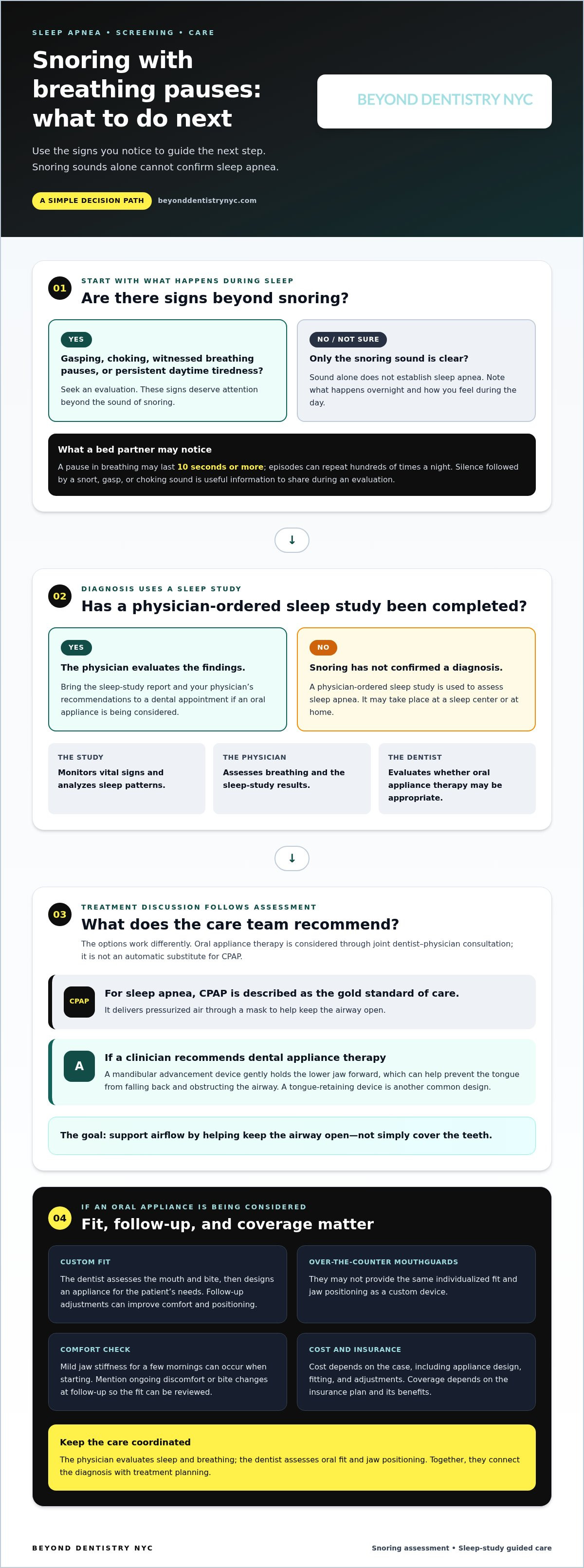
Snoring deserves closer attention when it comes with gasping, choking, or observed pauses in breathing. These signs can indicate obstructive sleep apnea, in which breathing repeatedly stops during sleep. A physician-ordered sleep study confirms the diagnosis; a dentist cannot diagnose sleep apnea from snoring sounds alone.
A sleep study may take place at a sleep center or at home. It monitors vital signs and analyzes sleep patterns to assess breathing. If you’re exploring an oral appliance, bring the results and your physician’s recommendations to your dental appointment. The dentist and physician work together to connect diagnosis with treatment planning.
Oral appliances may be appropriate for someone who snores or has sleep apnea when a clinician recommends dental appliance therapy. A mandibular advancement device gently holds the lower jaw forward, which can help prevent the tongue from falling back and obstructing the airway. A tongue-retaining device is another common design. The goal is to support airflow and reduce airway obstruction, not simply cover the teeth.
Custom fitting matters. The dentist assesses your mouth and bite, then designs an appliance for your needs; follow-up adjustments can improve comfort and positioning. Mild jaw stiffness for a few mornings can occur when starting a new snoring appliance. Mention ongoing discomfort or bite changes at follow-up so the fit can be reviewed.
For sleep apnea, CPAP is described as the gold standard of care. It uses pressurized air delivered through a mask to help keep the airway open, while an oral appliance repositions oral structures. The options work differently. Oral appliance therapy is considered through joint dentist-physician consultation, not as an automatic substitute for CPAP.
There isn’t one NYC price for snoring mouthguards or dental sleep appliances. The cost depends on the case and is given after a quote request; relevant factors include appliance design, fitting, and adjustments. Dental or medical insurance coverage also depends on your plan and its benefits, so review coverage for the specific appliance and diagnosis.
For suspected obstructive sleep apnea, a dentist’s role is to evaluate oral appliance therapy and coordinate care; diagnosis relies on a physician-ordered sleep study. Dr. David S. Binder is a Diplomate of the Academy of Dental Sleep Medicine, but that fact alone doesn’t identify every NYC dentist with sleep-medicine credentials. An oral surgery consultation is a separate consideration when a surgical approach is being assessed; an appliance consultation focuses on oral fit and airway positioning.
Snoring and obstructive sleep apnea
Snoring can be a clue, but its sound alone cannot diagnose obstructive sleep apnea. Look for breathing pauses, gasping, or daytime sleepiness, then follow up with sleep screening.
Nighttime Breathing Pauses
With obstructive sleep apnea, the airway narrows or closes during sleep, interrupting breathing. A pause may last 10 seconds or more, and episodes can repeat hundreds of times a night. Someone nearby may notice silence followed by a snort, gasp, or choking sound. Those observations are useful details to share during a sleep evaluation.
Keep track of what a bed partner observes, including whether pauses recur and whether you wake gasping. Daytime sleepiness, even after time spent in bed, adds important context. Snoring without these signs does not establish sleep apnea, but repeated breathing interruptions warrant a closer look.
Sleep Apnea Screening Before Treatment
Before treating snoring as an isolated concern, screening can help distinguish ordinary vibration from a breathing disorder. A physician-ordered sleep study can be done at a sleep center or at home. It monitors vital signs and analyzes sleep patterns, giving the physician information to assess possible sleep apnea.
Write down examples before the assessment: loud snoring, witnessed pauses, waking with a gasp, or persistent sleepiness. Share these observations along with any sleep-study findings. Screening matters because snoring treatment should reflect whether obstructive sleep apnea is present, not just how disruptive the sound seems.
Coordination with Physicians and Specialists
Sleep apnea care can involve both a physician and a dentist. The physician evaluates breathing and sleep-study results; the dentist assesses whether an oral appliance is appropriate. Joint consultation helps align the diagnosis with treatment planning, including whether jaw positioning may support airflow.
Bring the sleep-study report and your physician’s recommendations to a dental appointment. If an oral appliance is considered, the dentist can assess oral fit and jaw position while the physician remains involved in sleep apnea care. This coordinated approach connects airway concerns with appropriate treatment decisions.
Obstructive sleep apnea differs from central sleep apnea: central apnea involves disrupted nervous-system signals that control breathing. Identifying the type matters because the cause informs care. A sleep study provides information for the physician’s assessment, rather than relying on snoring alone.
Sleeping on your side instead of your back may help prevent the tongue from obstructing the airway. This practical sleep-position adjustment is not a substitute for assessment when breathing pauses or gasping occur. A sleep evaluation can clarify whether snoring is linked to obstructive sleep apnea.
After screening, the next conversation can focus on the findings and appropriate options. If dental appliance therapy is part of that discussion, explore dental sleep apnea care as one possible element of coordinated treatment.
Does a custom oral appliance work better than over-the-counter mouthguards?
A custom appliance is fitted to your mouth and may be designed to position your lower jaw forward. That differs from a general mouthguard, which isn’t individually made to advance the jaw.
Custom Appliances and Over-the-Counter Mouthguards
A mandibular advancement device is a custom-made mouthguard that holds the lower jaw forward to help prevent airway obstruction. By contrast, an over-the-counter mouthguard may cover the teeth without providing that planned jaw position. Focus on function: does the device fit your mouth and support the positioning recommended for your snoring or sleep apnea care?
Custom doesn’t mean every appliance suits every person. A dentist assesses your teeth, bite, and jaw before recommending a design. If you’re comparing a device described as Panthera with another option, ask how its planned jaw positioning and fit relate to your treatment goals. The brand name alone doesn’t show whether a particular design suits your needs.
Custom Fitting and Ongoing Monitoring
A custom oral appliance can be designed from a digital scan of your mouth and adjusted as needed. During fitting, the dentist considers how the appliance sits on your teeth and positions your lower jaw. A partner’s observations, such as continued loud snoring or gasping, can help describe what happens during sleep.
Follow-up matters because comfort and fit affect regular use. Track whether the appliance feels secure, whether your jaw feels stiff in the morning, and whether your partner notices a change in snoring. Slight jaw stiffness for a few mornings can occur when starting a new snoring appliance. Share persistent discomfort or bite changes at a follow-up visit.
In Midtown Manhattan and elsewhere in NYC, look for a dentist who provides oral appliance therapy and coordinates with a physician on sleep apnea care. Dr. David S. Binder is a Diplomate of the Academy of Dental Sleep Medicine. That credential identifies one NYC dentist; it isn’t a complete directory of practitioners.
For snoring alone, an appliance may be intended to prevent the tongue from falling back over the windpipe. If sleep apnea is suspected or diagnosed, treatment planning involves the physician as well as the dentist. A sleep study helps inform care; don’t assume a mouthguard is appropriate based only on snoring.
Bring practical details to your appointment: when you use a mouthguard, whether it stays in place, and what your partner notices. These examples help the dentist assess fit and discuss jaw positioning. The goal is to determine whether a custom appliance fits your oral health and sleep-care plan, rather than choosing by brand or appearance alone.
How airway narrowing causes snoring
Snoring begins when airflow moves through a narrowed passage and makes relaxed tissues vibrate. The soft palate, at the back of the roof of the mouth, is one such tissue. During sleep, reduced muscle tension can allow tissues in the mouth and throat to move into the airflow. The sound comes from vibration, not from the nose or throat “making noise” independently.
The location of narrowing helps explain why causes differ. Allergies and nasal congestion can narrow the nasal passages, changing how air moves during sleep. Farther back, relaxed soft tissues in the mouth and throat can restrict the passage and vibrate as a person breathes. More than one area can contribute, so the sound alone doesn’t identify the source.
The soft palate can vibrate as air passes around it, while the tongue can affect space farther back in the throat. A lower jaw that sits back can also affect the tongue’s position. A custom oral appliance positions the jaw and tongue forward, changing their relationship with the airway.
Notice the circumstances around the sound. For example, record whether snoring seems worse during nasal congestion, or whether a partner observes gasping and pauses. These details help distinguish changing nasal obstruction from signs that breathing is interrupted. Snoring has several causes; a sound recording cannot show whether airflow stops or identify the condition behind it.
Some contributors are temporary, such as allergy-related congestion, while others involve airway structures during sleep. Being overweight may also contribute to snoring. These examples describe possible influences, not a diagnosis. A clinician considers the pattern and other symptoms rather than treating every snore as evidence of obstructive sleep apnea.
A sleep study examines sleep patterns and vital signs when sleep apnea needs evaluation. It can help assess whether airway narrowing is accompanied by interruptions in breathing. For instance, persistent loud snoring with witnessed pauses warrants more attention than snoring alone. The results help distinguish vibration-related sound from a sleep-related breathing disorder.
In New York City, a dental assessment can consider whether jaw position and oral structures make an appliance appropriate. The dentist evaluates the mouth and bite, while sleep apnea assessment relies on a physician and sleep study. If breathing pauses, choking, or gasping accompany snoring, address those serious signs through sleep evaluation before focusing only on reducing noise.
When to consult a dentist about snoring
Consider a dental consultation when snoring persists, disrupts a partner’s sleep, or prompts questions about an oral device. Gasping, choking, or observed breathing pauses also call for medical assessment. A dentist can assess oral appliance therapy, while a physician evaluates possible sleep apnea. Each professional addresses a different part of the problem.
A dentist for snoring in NYC should provide oral appliance therapy and coordinate with a physician when sleep apnea is a concern. At the consultation, ask how the dentist evaluates jaw position and oral fit, handles follow-up, and relates treatment to your physician’s findings. Bring any sleep-study results and examples of nighttime symptoms.
Make the appointment more useful with a short symptom record. Note whether your partner sees pauses, hears gasping, or notices that you wake during the night. Include daytime sleepiness and any nasal congestion that coincides with louder snoring. These examples give the dentist and physician clearer context than snoring volume alone.
Ask what the proposed device is intended to do. For example, a mandibular advancement device positions the lower jaw forward to help reduce airway obstruction. Discuss how the appliance will be fitted, what adjustments may be made, and what signs should prompt follow-up. If your jaw feels stiff or your bite changes, report it rather than adjusting the device yourself.
Ask how dental care will connect with medical care. A physician’s assessment and sleep-study findings help establish whether obstructive sleep apnea is present. The dentist can then discuss whether an oral appliance fits the treatment plan. If you use CPAP or another prescribed treatment, share that information so the discussion reflects your current routine.
Some patients seek help because a partner can’t sleep; others wake with a dry mouth or feel tired during the day. These concerns are useful to mention, but they don’t diagnose sleep apnea. Keep the distinction clear: the dentist evaluates whether oral appliance therapy is suitable, while diagnosis and broader sleep treatment involve medical care.
For your consultation, bring your symptom notes, sleep-study information, and a list of current devices or treatments. Ask how fit and comfort will be reviewed over time, and how the dentist will coordinate with your physician. If you’re ready to discuss oral appliance therapy as part of functional dental care, schedule a snoring consultation.
Beyond Dentistry NYC: Smile Gallery Restorations
Beyond Dentistry NYC provides sleep apnea appliances for patients exploring dental appliance therapy as part of coordinated care. After a physician’s sleep evaluation, a discussion of oral appliance options can clarify how dental treatment may fit the care plan and what to consider about comfort, fit, and follow-up.
The practice also provides Smile Gallery Restorations, functional dentistry, and innovative technology treatments. If snoring has you considering a dental appliance, bring your sleep-study findings and physician’s recommendations to the discussion. This connects your sleep concerns with your oral health and the treatment options you’re exploring.
Contact Beyond Dentistry NYC to discuss sleep apnea appliances and your next steps.
Take the Next Step Toward More Restful Sleep
Take the next step with a clear conversation about what you want to address: disruptive snoring, concerns about nighttime breathing, or whether a dental device belongs in your care plan. A dentist for snoring in NYC can discuss the dental side of treatment, while your physician remains central to sleep apnea diagnosis and medical care.
Before reaching out, decide what would make the discussion most useful. You might want to understand how oral appliance therapy fits with your current care, what the evaluation involves, or how dental and medical guidance work together. Bringing one or two priorities can help keep the conversation focused on your needs.
For a personal discussion about your snoring concerns and possible dental next steps, contact Beyond Dentistry NYC. A thoughtful plan starts with asking the right questions, and you can take that step at your own pace.
Frequently Asked Questions
What is snoring?
Snoring is a sound created when airflow makes relaxed tissues in the mouth or throat vibrate during sleep. Its volume doesn’t show whether breathing is interrupted. For example, someone may snore without witnessed pauses, while another person’s snoring comes with gasping. Note the pattern and accompanying signs rather than judging the concern by sound alone. Persistent snoring can also dry the mouth, which matters for oral health.
What types of oral appliances are used to treat snoring?
Common oral appliances include mandibular advancement devices and tongue-retaining devices. A mandibular advancement device holds the lower jaw forward, while a tongue-retaining device is designed to hold the tongue forward. The designs affect oral structures differently, so the right choice depends on the dental assessment and sleep-care plan. A dentist considers fit and jaw position, while a physician’s evaluation informs care when sleep apnea is involved.
Can allergies or nasal congestion contribute to snoring?
Yes. Allergies and nasal congestion can narrow the nasal passages and contribute to snoring by affecting airflow during sleep. Notice whether snoring changes during periods of congestion, and share that pattern during an evaluation. Nasal symptoms don’t establish the cause of every snore, and congestion alone doesn’t diagnose sleep apnea. Gasping, choking, or observed breathing pauses call for attention beyond nasal symptoms.
Do snoring appliances feel comfortable?
Comfort depends on how an appliance fits and how your mouth responds as you begin using it. A custom device can be adjusted, so report pressure, looseness, or difficulty wearing it at follow-up. Slight jaw stiffness for a few mornings can occur when starting a new snoring appliance. If discomfort persists or your bite feels different, tell the dentist rather than changing the device yourself.
How does snoring affect my oral health?
Chronic snoring can contribute to dry mouth, which reduces saliva and increases the risk of tooth decay and gum disease. You might wake with a dry mouth or need water overnight. Mention these symptoms during a dental visit, especially if they occur regularly. The dentist can consider dry mouth alongside your broader oral health needs. Snoring-related dryness is a reason to pay attention, not a diagnosis of dental disease.
How is dentistry involved?
Dentistry can support snoring care by assessing whether an oral appliance is appropriate and fits your teeth and jaw. When sleep apnea is involved, a dentist works with the physician on diagnosis, treatment planning, and ongoing care. Bring details such as device discomfort or a partner’s observations to appointments. Dental evaluation supports the oral-appliance component; it doesn’t replace a physician’s sleep apnea assessment.
How soon will I see results?
Starting oral appliance therapy can take several weeks to several months. The process includes designing or fitting the device and making adjustments for fit and comfort. Keep notes during that period: record whether you can wear it as directed, how your jaw feels in the morning, and what a partner observes. Share these details at follow-up so the care team can assess progress and discuss next steps.
How do dentists evaluate snoring and determine whether a sleep study is needed?
A dentist reviews your symptoms, oral structures, and jaw position, then coordinates with a physician when sleep apnea is a concern. Gasping, choking, witnessed breathing pauses, or daytime sleepiness are useful details to report. A physician-ordered sleep study, conducted at a sleep center or at home, assesses sleep patterns and vital signs. The dentist’s evaluation informs appliance care; the sleep study supports medical diagnosis.


