

Could a more advanced dental tool make care feel less personal? It shouldn’t. Innovative technology treatments can support how a dentist assesses your needs and plans care, but the right approach still begins with listening to your concerns and explaining your options clearly.
If you’re unsure what technology does during a visit, or how to compare claims between practices, you’re not alone. This article explains how technology may inform assessment and treatment planning, what to ask before proceeding, and why tools alone can’t guarantee a result. We’ll consider how a technology-led approach may relate to dental implants, sleep apnea appliances, veneers, and smile makeovers. At Beyond Dentistry NYC, a conversation can begin with your goals and concerns, then explore which treatment options may be relevant. A useful consultation should help you understand your choices and take part in decisions about your care.
Key Takeaways
- Innovative technology treatments may support dental assessment, planning, or care, but tools don’t replace a dentist’s clinical judgment.
- Technology may be relevant to discussions about TMD therapy, implants, sleep apnea appliances, and smile restorations.
- When comparing technology claims, ask what a tool is intended to help assess and how it relates to your individual needs.
- Prepare for a useful consultation by sharing your concerns, relevant history, prior treatment, and goals.
- Learn how Beyond Dentistry NYC’s technology-led approach may connect with its confirmed treatment options.
What innovative technology treatments mean in modern dentistry
In modern dentistry, innovative technology treatments refers to tools or systems that may support assessment, treatment planning, or parts of care. A tool can provide information, but it doesn’t independently diagnose a concern or decide which treatment is right for you.
Its relevance depends on why you’re visiting, the care being considered, and your individual circumstances. A tool that may be useful in one plan may not be needed in another, including for TMD therapy. Ask how any proposed technology relates to your concern and what other information the clinician will consider.
How technology fits into an individualized dental care plan
Your conversation comes first. A dentist can consider your symptoms, relevant health and dental history, examination, and goals when discussing next steps. Technology may add information to that assessment or help inform planning, but it isn’t a substitute for understanding what you’re experiencing.
For example, a practice may describe a technology-led approach, but that doesn’t mean every person seeking TMD therapy needs the same tool or treatment. Ask what question the technology is meant to address and how its findings would affect the recommendation.
What patients should, and should not, expect from dental technology
Technology can be part of a clinical process without promising a particular experience or result. A tool’s role in supporting precision doesn’t guarantee greater comfort, faster care, or a specific outcome. Your clinician’s assessment and judgment remain central, so ask what the technology is intended to contribute to your plan.
Some technology categories are used in dentistry generally, but that doesn’t confirm that a particular practice uses them. CAD/CAM technology, for instance, is a broad term for computer-aided design and manufacturing in dentistry. Treat it as background, not as a claim about tools available at Beyond Dentistry NYC. Confirm specific systems with the practice.
Technology may support the process of care, but it can’t guarantee a clinical outcome. Before proceeding, consider asking: What question is this tool helping address? How does it relate to my symptoms and goals? What information will inform the recommendation, and what are my options? Clear answers help you understand the plan and stay involved in decisions.
How technology may support TMD, implants, sleep apnea, and restorations
Technology doesn’t have one universal role across dental care. Your concern helps shape which assessment and treatment questions matter, and whether technology has a relevant part to play. Beyond Dentistry NYC offers TMD therapy, dental implants, sleep apnea appliances, smile makeovers, veneers, and restorative dentistry. Specific tools used for these services aren’t confirmed here, so ask what a proposed technology does and how it fits your care.
Technology and personalized TMD care
TMD care starts with understanding your symptoms, dental and health history, examination, and goals. If you’re seeking help with jaw discomfort or another concern, ask how the clinician will assess it and whether technology is part of that process. Beyond Dentistry NYC offers TMD therapy, but the role of a specific tool should be explained rather than assumed. You can also ask what options may be considered and why they fit your circumstances.
If you’re looking for background before a conversation, the practice’s TMD dental care in NYC guide may help you identify questions to raise.
Technology in implant, sleep apnea, and restorative treatment
Implant care, sleep apnea appliances, and restorative treatment address different needs. An approach relevant to one isn’t automatically appropriate for another. For implants, ask how your individual evaluation informs the proposed plan. If you’re exploring a sleep apnea appliance, clarify what the practice provides and what assessment is needed. The availability of appliances alone doesn’t establish that the practice provides sleep apnea diagnosis. For restorations, ask how any technology contributes to planning the care being discussed.
Technology and smile makeovers or veneers
For a smile makeover or veneers, discuss what you hope to change and how the proposed care relates to your dental needs. Ask whether technology is used in planning, what it can help you understand, and what it can’t predict about your final result. Beyond Dentistry NYC offers smile makeovers and veneers; confirm specific tools directly with the practice. If you’re weighing aesthetic goals, its smile makeover guide may offer a useful starting point for questions.
Technology use depends on the treatment plan, not the other way around. Ask whether a tool is relevant to your concern, how it informs the clinician’s recommendation, and what alternatives you can discuss. To explore whether TMD therapy, implant care, sleep apnea appliances, or restorative options may fit your needs, consider a conversation about technology-informed dental care with Beyond Dentistry NYC.
Comparing technology claims: what matters beyond the device
A practice may describe its equipment as advanced, precise, or innovative. Those words alone don’t tell you whether a tool is relevant to your concern or how it may inform care. When comparing consultations in New York City, look beyond the device. Focus on its purpose, how the clinician interprets the information, and how the explanation connects to your needs.
Use this framework to turn a technology claim into a practical question:
| What to compare | Technology feature | Question for your care |
|---|---|---|
| Purpose | A tool is described as supporting assessment or planning. | What concern is it intended to help evaluate or address? |
| Relevance | A practice highlights a particular technology. | How does it relate to my symptoms, history, or treatment goals? |
| Clinician explanation | The tool produces information or an image. | How will you interpret this information, and could it change the recommendation? |
| Follow-up | The technology is presented as part of a treatment process. | What happens next, and what follow-up may be relevant to this plan? |
A newer or more sophisticated device doesn’t, by itself, establish that a treatment is suitable. The clinical question matters more: what does the clinician need to understand, and how could that information contribute to an individualized recommendation? Innovative technology treatments are most useful to patients when their purpose and limits are explained in plain language.
Questions to ask about a technology-assisted recommendation
Before agreeing to a proposed plan, ask direct questions: What concern does this technology help evaluate? How might its findings affect my recommendation? What are the alternatives, limitations, and relevant follow-up? Clear answers help you understand the clinician’s reasoning rather than relying on a device’s name or a broad claim.
How to assess claims about precision, comfort, or results
Ask what a claim means for the care being proposed. “More precise” should prompt a conversation about which part of the process the tool supports and how that matters in your case. A general statement about comfort or results isn’t a personal prediction. The clinician should explain what can reasonably be expected, what remains uncertain, and how their assessment shapes the plan.
Compare the explanation, not just the equipment. A thoughtful consultation makes room for your questions, discusses relevant alternatives, and connects any technology to your needs. You should understand why a tool is being considered and what it cannot tell you.
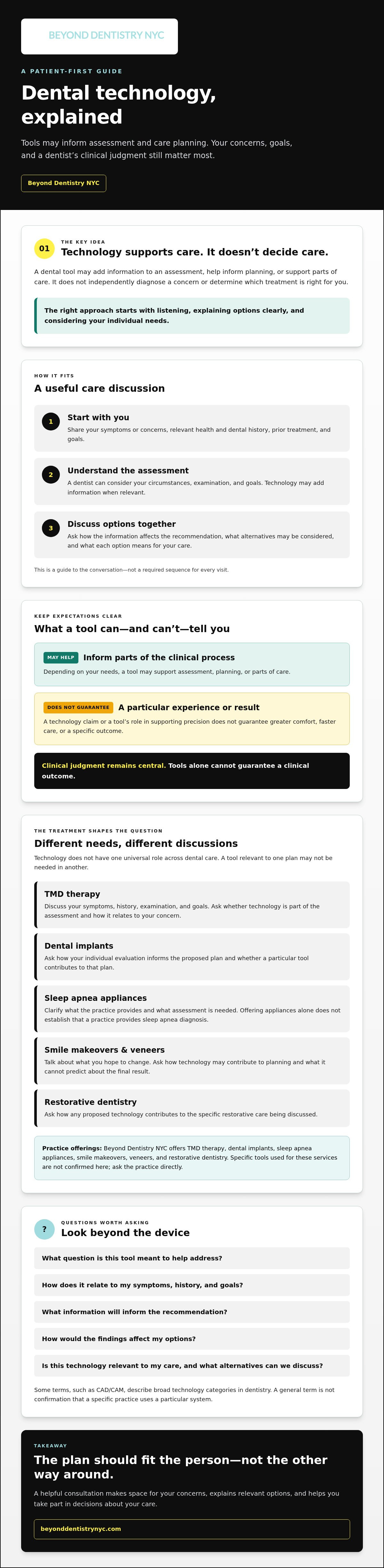
What to expect when discussing technology-supported dental care
A useful conversation about care isn’t a technology checklist. It’s a chance to explain what’s bothering you, understand the clinician’s assessment, and explore options that fit your needs. Recommendations should follow clinical evaluation, not simply the availability of a particular tool.
Prepare for a productive consultation
Before your visit, jot down what you’ve noticed and what you hope to address. You don’t need technical knowledge or the perfect words. A short list can help keep the discussion focused on what matters to you.
- Describe your concerns: Note your symptoms, when they occur, and what you’d like help understanding.
- Share relevant history: Mention previous dental care, prior treatment, and health information that may be useful to the clinician.
- Identify your priorities: Consider what you hope to achieve and any questions or worries you want addressed.
These details give the clinician context, but they don’t mean a particular scan, test, or procedure will be needed. If a technology-assisted step is suggested, ask what it is intended to contribute to your assessment or plan.
Review recommendations at a comfortable pace
After the clinician reviews your concerns and assessment, take time to understand the options. Ask how each recommendation relates to your goals and the findings discussed. If technology is part of the plan, ask what information it provides, how that information will be considered, and what its limitations are.
It’s also reasonable to ask about alternatives and follow-up. If an explanation feels unclear, ask for it in different words. Requesting clarification is a normal part of informed care, not a challenge to the clinician’s expertise.
Innovative technology treatments should support a thoughtful care plan, not replace a conversation about your needs. A clear discussion can help you understand the reasoning behind a recommendation and decide what questions you still have.
If you’re considering care at Beyond Dentistry NYC, you can Discuss your dental care questions with the team.
Explore technology-informed care at Beyond Dentistry NYC
Beyond Dentistry NYC describes its approach as using innovative technology treatments to support clinical care. The practice offers TMD therapy, dental implants, sleep apnea appliances, Botox, smile makeovers, veneers, and restorative dentistry. Specific tools or systems aren’t confirmed here, so ask what technology may be relevant to your concern and how it would inform your care.
A technology-led approach doesn’t mean one standard plan for every patient. Recommendations depend on your needs and a professional evaluation, including a conversation about your concerns and goals. The aim is to understand your options, not to assume a particular service or tool is right for you.
Match the conversation to your dental concern
If you’re experiencing jaw-related concerns, ask whether TMD therapy may be worth discussing. For missing teeth, ask about dental implant care and how the clinician would assess your circumstances. If you have sleep concerns, the practice offers sleep apnea appliances; a conversation can clarify whether this service may be relevant without assuming a diagnosis or treatment recommendation. Smile goals may lead to questions about smile makeovers, veneers, or restorative dentistry.
These are starting points, not self-diagnoses. A symptom or goal alone can’t determine which care is appropriate. Share what you’ve noticed, relevant history, prior treatment, and what you hope to address. Then ask how the clinician’s evaluation informs any recommendation and whether technology has a specific role in the proposed plan.
For more background, explore the practice’s TMD dental care in NYC guide or its functional dentistry guide. Each can help you prepare questions without replacing a personalized conversation.
Continue the conversation at your pace
Ask which options fit your concerns, what a proposed tool is meant to support, and what alternatives may be discussed. If an explanation feels too technical, request a clearer one. Feeling informed means understanding not just what is recommended, but why it may be relevant to you.
If you’re considering care in New York City, a conversation with the team can help you explore whether TMD therapy, implants, sleep apnea appliances, Botox, or smile restorations relate to your needs. Contact Beyond Dentistry NYC to discuss your care and bring the questions that matter to you.
Take the Next Step Toward Care That Fits You
Dental technology can inform assessment and planning, but the clinician’s evaluation and your individual needs guide care. Ask what a tool is intended to help with, how it relates to your concerns, and what options you can consider. These conversations can make innovative technology treatments easier to understand and help you take part in decisions.
Beyond Dentistry NYC provides restorative, functional, and technology-focused dental care, including TMD therapy, dental implants, sleep apnea appliances, Botox, and smile makeovers. Whether you’re exploring care for jaw concerns, missing teeth, sleep-related concerns, or smile goals, a discussion can help clarify what may be relevant to your circumstances. No device alone can determine the right plan or guarantee a result.
Bring your questions and goals to a conversation with the team. Contact Beyond Dentistry NYC to discuss your care and explore your options at a comfortable pace. A clear, individualized conversation is a thoughtful place to begin.
Frequently Asked Questions
What are innovative technology treatments in dentistry?
Innovative technology treatments are tools or systems that may support dental assessment, treatment planning, or care. They can contribute information to a clinician’s evaluation, but they don’t independently diagnose a condition or select treatment. The specific technology used varies by practice and patient needs. In New York, ask what a proposed tool is intended to do and how it relates to your concern.
Can dental technology improve treatment planning?
Dental technology may provide information that helps a clinician consider treatment options and plan care. Its usefulness depends on the clinical question and your circumstances. Ask how findings may affect a recommendation, what other information the dentist will consider, and whether alternatives are available. Technology can support planning, but it doesn’t guarantee a particular result or replace the clinician’s judgment.
Is technology-assisted dental treatment right for everyone?
No. A technology-assisted step may be relevant for one person and unnecessary for another. Recommendations depend on your symptoms, dental and health history, examination, and goals, rather than a standard technology checklist. Ask why a tool is being considered, what it can and can’t contribute, and whether other approaches may be discussed. You should feel comfortable asking for an explanation before deciding how to proceed.
How is technology used in TMD dental care?
Technology may have a role in a TMD assessment or treatment plan, but specific tools and their use depend on the clinician and your needs. Beyond Dentistry NYC offers TMD therapy; its specific technology systems aren’t confirmed here. If you’re discussing jaw concerns in New York City, ask how your symptoms and clinical evaluation inform the recommendation, and whether any proposed technology contributes to the assessment or plan.
Can dental technology help with implants or sleep apnea appliances?
Technology may support planning or care discussions for dental implants or sleep apnea appliances, but the appropriate approach depends on an individual evaluation. Beyond Dentistry NYC offers both services, though specific tools used for them aren’t confirmed here. Ask how proposed technology relates to your treatment plan and what assessment informs the recommendation. An appliance offering doesn’t, by itself, establish that the practice provides sleep apnea diagnosis.
What should I ask a dentist about innovative technology treatments?
Ask what concern the technology is meant to help evaluate, how its findings may affect your care plan, and what limitations or alternatives to consider. You can also ask what follow-up may involve and how the recommendation connects to your symptoms, history, and goals. These questions help distinguish a technology feature from a benefit relevant to your care. Requesting clarification is a normal part of an informed dental conversation.


