

Could the mouth guard you’re considering protect your teeth without addressing the sleep apnea affecting your rest? Searching “sleep apnea mouth guard nyc” often starts with that question. It’s understandable to look for a comfortable alternative to CPAP, especially when over-the-counter guards and custom devices can sound alike.
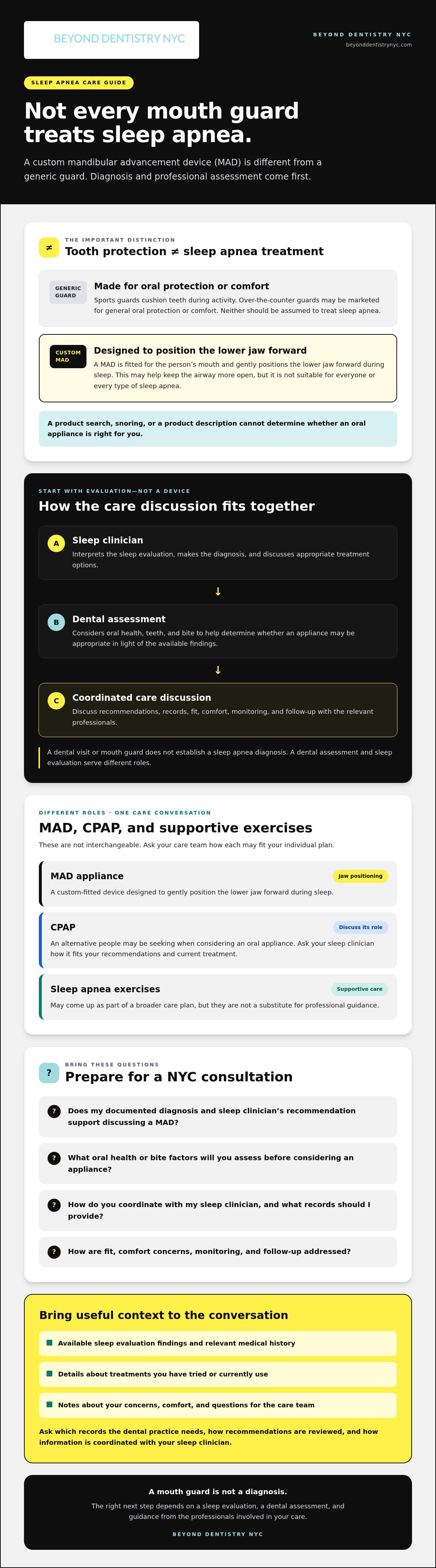
They aren’t interchangeable. A generic mouth guard is usually made to protect teeth, while a custom mandibular advancement device (MAD) is designed to gently position the lower jaw forward during sleep. Whether an oral appliance is appropriate depends on a sleep apnea evaluation and a dental assessment, not just a purchase. Sleep apnea exercises may also come up as part of a broader care plan, but they aren’t a substitute for professional guidance.
This guide explains how diagnosis, MAD appliances, CPAP, and supportive exercises fit into a care discussion. It also offers practical questions to ask a sleep clinician and a New York City dental practice about records, fit, comfort, and follow-up.
Key Takeaways
- A sleep apnea mouth guard in NYC may mean a custom mandibular advancement device, not a generic guard intended to protect teeth.
- Bring available sleep evaluation records, details about current treatment, and notes about your concerns to conversations with your sleep clinician and dental practice.
- MAD appliances, CPAP, and clinician-guided sleep apnea exercises have different roles. Ask how each may fit into your care plan.
- Before considering an oral appliance, clarify what your sleep clinician recommends and what a dental assessment can help determine.
- Beyond Dentistry NYC lists sleep apnea appliances among its services. Discussing your evaluation and preferences can help inform next steps without assuming a particular device is right for you.
What Does a Sleep Apnea Mouth Guard in NYC Actually Do?
A sleep apnea mouth guard can refer to different devices, and the distinction matters. A mandibular advancement device (MAD) is fitted for a person’s mouth and intended to gently position the lower jaw forward during sleep. This may help keep the airway more open, but it isn’t suitable for everyone or every type of sleep apnea.
If you’re searching “sleep apnea mouth guard nyc,” think of a custom appliance as one possible treatment to discuss after a sleep evaluation, not as a substitute for diagnosis. A sleep clinician determines whether sleep apnea is present and discusses care options. A dental assessment can then help consider whether an oral appliance may be appropriate for your circumstances.
How does a mandibular advancement device work?
The appliance fits over the teeth and is designed to position the lower jaw slightly forward while you sleep. Changing the jaw’s position may also affect the position of the tongue and tissues around the airway. A mandibular advancement splint is another term for this general type of device. Designs and treatment plans can differ.
Fit is an important part of the clinical discussion. A dental professional can assess your teeth and bite and consider whether an appliance may be worth discussing in light of your sleep clinician’s findings. No mouth guard can promise symptom relief, and a device shouldn’t be chosen based only on snoring or a product description.
Is a sleep apnea mouth guard the same as a regular mouth guard?
Usually, the intended purposes differ. A sports mouth guard is meant to cushion teeth during activity, while an over-the-counter guard may be marketed for general oral protection or comfort. Neither should be assumed to treat sleep apnea simply because it sits in the mouth. Searching “sleep apnea mouth guard nyc” doesn’t make a generic guard a clinically selected appliance.
A sleep apnea oral appliance is considered in a clinical care context. A sleep evaluation informs the diagnosis and treatment discussion, while a dental assessment considers fit and oral health. If you have concerns about breathing during sleep, persistent snoring, or disrupted rest, seek evaluation from a sleep clinician rather than relying on a store-bought guard. This section is educational, not a diagnosis or prescription.
How Diagnosis Guides Sleep Apnea Mouth Guard Treatment
Choosing an appliance starts with an understanding of your sleep health, not a product search. If you’re researching “sleep apnea mouth guard nyc,” use that search to find questions for your care team, not to determine which device you need. A sleep clinician interprets an evaluation, makes the diagnosis, and discusses appropriate treatment options.
A dental assessment adds a different perspective. The dentist can consider oral factors relevant to an appliance in light of the available findings. These conversations can inform one another, but a dental visit or mouth guard doesn’t establish a sleep apnea diagnosis. The National Heart, Lung, and Blood Institute reviews sleep apnea treatment options that patients can discuss with their clinician.
What happens before a dentist considers a MAD?
For a more focused discussion, bring available sleep evaluation findings and relevant medical history, along with notes about treatments you’ve tried or currently use. Ask the dental practice which records it needs and whether it reviews recommendations from your sleep clinician. Coordination processes can differ, so confirm how information is shared and who to contact if the dental discussion raises questions for your sleep clinician.
A search for “sleep apnea mouth guard nyc” may surface different kinds of guards and providers, but it can’t determine whether a mandibular advancement device is appropriate. That decision should be considered in the context of your diagnosis and care recommendations, with the relevant professionals involved.
Which questions should you bring to a NYC consultation?
Use the appointment to clarify how the dental assessment connects with your existing sleep care plan. Consider asking:
- Does my documented diagnosis and sleep clinician’s recommendation support discussing a MAD?
- What oral health or bite factors will you assess before considering an appliance?
- How do you coordinate with my sleep clinician, and what records should I provide?
- How are fit, comfort concerns, monitoring, and follow-up addressed?
Beyond Dentistry NYC lists sleep apnea appliances among its services. Ask the practice directly about its current process for reviewing records and coordinating care. You can explore a sleep apnea appliance consultation as one part of a broader discussion with your sleep care team.
MAD, CPAP, and Sleep Apnea Exercises: How to Compare Their Roles
These options serve different purposes, so they shouldn’t be treated as interchangeable. A mandibular advancement device (MAD) is an oral appliance that positions the lower jaw forward during sleep. CPAP uses a machine to deliver pressurized air through a mask to help keep the airway open. Sleep apnea exercises are a separate approach that may be discussed as part of care. Your sleep clinician can explain which options, or combination of options, may make sense for your diagnosis and circumstances.
| Option | General purpose | Care context |
|---|---|---|
| MAD appliance | Positions the lower jaw forward during sleep. | A dental assessment and sleep clinician input help inform whether an oral appliance is appropriate. |
| CPAP | Provides pressurized air during sleep through a mask. | Discuss use, comfort, and any concerns with the clinician overseeing your sleep care. |
| Clinician-guided exercises | Exercises may be considered as a distinct part of a care discussion. | Ask a qualified clinician whether they’re relevant alongside, or separate from, other treatment. |
The American Academy of Dental Sleep Medicine describes oral appliance therapy as a treatment approach involving dental care. A sleep apnea mouth guard in NYC should be considered within a broader clinical plan, not selected as a stand-alone substitute for evaluation or other recommended treatment.
When might someone discuss a MAD instead of CPAP?
A MAD may come up in a conversation about treatment options, but whether to consider one depends on your diagnosis, clinical factors, and preferences. A sleep clinician can explain how an oral appliance compares with CPAP for your situation. A dental professional can assess oral factors relevant to an appliance. For a fuller discussion of those differences, see the guide to oral appliances versus CPAP. Neither option should be assumed to suit everyone.
Where do sleep apnea exercises fit into care?
Exercises aren’t a way to diagnose sleep apnea, and readers shouldn’t rely on them instead of evaluation or prescribed treatment. If you’re curious about this approach, ask your sleep clinician whether it belongs in your care plan. The guide to myofunctional therapy for sleep apnea offers more context on exercises and questions to raise with a qualified clinician.
How to Prepare for a Sleep Apnea Mouth Guard Consultation in NYC
A little preparation can make a dental conversation about an oral appliance more useful. If you’re exploring a sleep apnea mouth guard in NYC, bring the information you have and use the visit to clarify what a dental assessment can address. You don’t need to arrive with a treatment decision already made.
What information should you bring to the appointment?
Before your visit, ask the practice which records are useful for its evaluation process. If available, bring your sleep evaluation results and recommendations from your sleep clinician. Also make a brief list of current treatments, relevant medical history, and concerns you’d like to discuss.
Personal observations can help guide the conversation, but they aren’t a diagnosis. Note what you’ve noticed, such as disrupted rest or concerns raised by someone who shares your bedroom. Keep the details factual and let your sleep clinician interpret them in the context of an evaluation.
- Available sleep study or evaluation results
- Recommendations or notes from your sleep clinician
- A list of current treatments and relevant medical history
- Questions or observations about sleep and comfort
What should you ask about appliance fit and follow-up?
Ask how the practice evaluates whether an appliance may be appropriate, how fit is assessed, and what to do if you have discomfort. You can also ask how the appliance will be checked over time, what monitoring may involve, and whom to contact if symptoms change or the device feels uncomfortable.
Care coordination matters, too. Ask how the dental plan will reflect your sleep clinician’s recommendations, whether the practice reviews sleep evaluation records, and how communication between providers is handled. Follow-up arrangements can vary, so confirm the practice’s current process rather than assuming a particular schedule or service is included.
A focused conversation, not a rushed decision
These questions can help you understand the next step without treating a dental consultation as a substitute for sleep care. The aim is to bring evaluation findings, dental considerations, and your preferences into the same discussion, with clear answers about what the practice can assess and what requires input from your sleep clinician.
Beyond Dentistry NYC lists sleep apnea appliances among its clinical services. To learn more about the practice’s sleep apnea appliance care, ask how its current consultation process addresses records, fit, follow-up, and coordination with sleep clinicians.
Explore Sleep Apnea Appliance Care with Beyond Dentistry NYC
Choosing a next step starts with understanding what’s known and what still needs evaluation. A sleep clinician determines whether sleep apnea is present and discusses treatment options. If an appliance enters that conversation, a dental assessment and your preferences can help inform whether it’s appropriate to explore. This article is educational; it can’t diagnose sleep apnea or determine which treatment is right for you.
Beyond Dentistry NYC is a New York City practice focused on functional dentistry and lists sleep apnea appliances among its clinical services. It may be a point of contact for a dental discussion about appliances, but it doesn’t replace sleep evaluation or care from a sleep clinician. No particular device or outcome can be assumed before your circumstances are reviewed.
What to expect when discussing an appliance with the practice
Use a consultation to share relevant records, describe what matters to you, and ask what options may be available for discussion. You can ask what information the practice needs, how it considers your sleep clinician’s recommendations, and what the next steps might involve. Confirm the practice’s current assessment, coordination, and follow-up process directly.
Keep your sleep clinician involved as you consider care. If you’ve already been evaluated, ask how a dental discussion can align with the recommendations you received. If you haven’t had an evaluation, contact a qualified sleep clinician about assessment before treating a mouth guard as a sleep apnea solution. Searching for a sleep apnea mouth guard in NYC can help you prepare questions, but it can’t determine your diagnosis or whether an appliance is suitable.
Choose a next step that fits your care plan
Bring your questions, available evaluation records, and preferences into the conversation. You may want to discuss comfort, oral health considerations, follow-up, or how the dental team communicates with your sleep clinician. Clear answers can help you understand the process without feeling pressured to choose a treatment before the appropriate professionals have weighed in.
If you’d like to ask about the practice’s sleep apnea appliance services, contact Beyond Dentistry NYC to discuss an appointment and what information to bring. Your sleep clinician remains an important partner in diagnosis and treatment decisions.
Make Your Next Step an Informed One
A mouth guard isn’t a one-size-fits-all answer to sleep apnea. Base treatment decisions on a professional evaluation, then discuss whether a mandibular advancement device, CPAP, exercises, or another approach fits your care plan. A dental conversation can add insight about oral appliance considerations, but it doesn’t replace diagnosis by a sleep clinician.
If you’re researching a sleep apnea mouth guard in NYC, Beyond Dentistry NYC lists sleep apnea appliances among its clinical services and focuses on functional dentistry. You can ask the practice about discussing appliance care alongside recommendations from your sleep clinician, without assuming a specific device or outcome is right for you.
Bring your questions, share the information you have, and take the next step at a pace that feels right. Contact Beyond Dentistry NYC to discuss sleep apnea appliance care and what to ask about an appointment. A thoughtful conversation can help you move forward with greater clarity.
Frequently Asked Questions
Is a mouth guard effective for sleep apnea?
A custom oral appliance may be an appropriate treatment option for some people with obstructive sleep apnea, but effectiveness and suitability depend on the individual diagnosis and clinical assessment. A generic sports or over-the-counter guard shouldn’t be assumed to treat sleep apnea. Discuss symptoms and evaluation results with a sleep clinician, who can explain care options and whether an oral appliance merits a dental assessment.
Can a dentist make a mouth guard for sleep apnea in NYC?
Some dental practices provide sleep apnea appliances, but the care discussion should follow a sleep evaluation and diagnosis by a sleep clinician. In New York City, ask the dental practice what records it needs, how it considers your clinician’s recommendations, and what its current appliance assessment process includes. Beyond Dentistry NYC lists sleep apnea appliances among its services, but an appointment can’t guarantee that an appliance will be suitable for you.
What is the difference between a MAD and a regular mouth guard?
A mandibular advancement device (MAD) is an oral appliance intended to position the lower jaw forward during sleep as part of sleep apnea care. A regular sports guard is designed to protect teeth during activity, and a general over-the-counter guard isn’t selected based on a sleep diagnosis. Their appearance may seem similar, but their intended use and clinical context differ. Ask a clinician before using any device as sleep apnea treatment.
Do I need a sleep apnea diagnosis before getting an oral appliance?
A sleep evaluation and diagnosis should guide consideration of a custom oral appliance. A sleep clinician determines whether sleep apnea is present and discusses appropriate treatment options; a dental assessment can then consider oral factors relevant to an appliance. A mouth guard can’t establish or confirm the diagnosis. If you haven’t been evaluated, discuss your symptoms with a qualified sleep clinician before pursuing an appliance as treatment.
Can sleep apnea exercises replace a mouth guard or CPAP?
Don’t assume exercises can replace a prescribed appliance or CPAP. They’re a separate topic to discuss with your sleep clinician, who can help determine whether they have a role alongside your care plan. Exercises also can’t diagnose sleep apnea. If you’re interested in trying them, ask how they relate to your diagnosis and current treatments rather than stopping or changing treatment on your own.
How do I know whether a MAD or CPAP is right for me?
Your sleep clinician can help compare a MAD and CPAP using your diagnosis, clinical factors, and preferences. A MAD involves a dental appliance, so a dental assessment may also be needed to discuss oral health and fit considerations. Neither option is right for everyone, and one shouldn’t be treated as a universal substitute for the other. Ask your care team to explain its recommendation and how progress will be reviewed.
What should I bring to a sleep apnea appliance consultation?
Bring available sleep evaluation results, relevant medical history, a list of current treatments, and recommendations from your sleep clinician if you have them. Write down concerns such as discomfort with current treatment or changes you’ve noticed in your sleep. These observations can support a conversation but don’t establish a diagnosis. Before your NYC appointment, ask the practice which records are useful and what questions to prepare about fit, comfort, coordination, and follow-up.


