

What if a beautiful smile started with more than the teeth you see? Smile reconstruction brings appearance and function into the same plan, considering how your teeth and jaw work together and whether other concerns should be assessed. The goal isn’t a uniform, “perfect” look. It’s a result that feels natural to you and supports your oral health.
If you’re concerned that veneers or other restorative work might look artificial, or you’re dealing with jaw discomfort or sleep concerns, it’s reasonable to want clear answers before committing. Treatment involving several teeth can also feel difficult to coordinate when the options, sequence, and appointments aren’t yet clear.
This guide explains how smile makeovers differ from functional reconstruction and what to consider when discussing veneers, dental implants, adult orthodontics, or a mandibular advancement device (MAD). You’ll also find questions to bring to a consultation. At Beyond Dentistry NYC, Drs. Morgan and Michael Herman bring functional dentistry, smile makeover expertise, and treatments for TMD and sleep apnea into a thoughtful approach to care. The aim is a clear roadmap toward aesthetics and function that work together.
Key Takeaways
- Understand how smile reconstruction differs from a cosmetic makeover, and why a treatment plan may address oral function as well as appearance.
- Ask whether adult orthodontics could help prepare your teeth for restorative care, such as veneers or dental implants.
- Compare restorative options by considering your goals, the condition of your teeth, and questions about material suitability and biocompatibility.
- Know what to discuss during an initial functional assessment, including jaw comfort and airway or sleep concerns.
- Learn when sleep apnea evaluation and a mandibular advancement device may fit into a broader care plan.
Defining Smile Reconstruction: More Than Just a Cosmetic Makeover
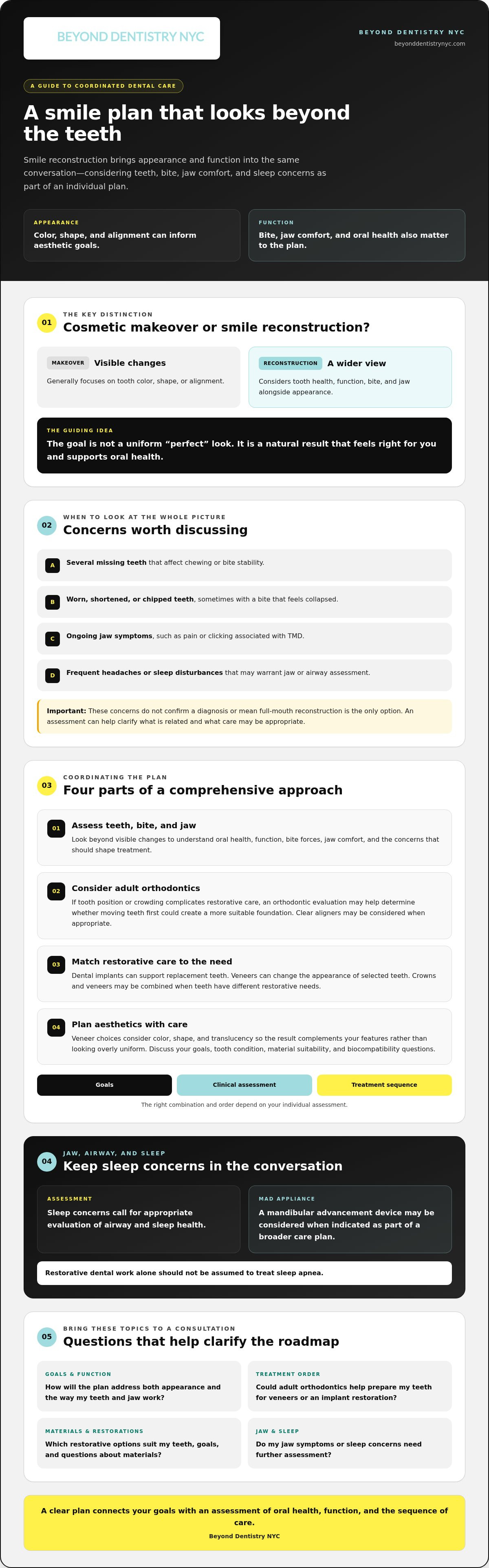
A smile can look polished while the forces behind it remain unbalanced. Smile reconstruction takes a broader view, bringing together the health, function, and appearance of the teeth. It also considers how the bite and jaw may affect a treatment plan. Reconstruction may involve restorative care such as veneers or dental implants, but the right combination depends on an individual assessment.
The term can mean different things in different clinical contexts. For example, smile surgery often describes procedures that restore facial movement and smiling ability, including after facial paralysis. Dental smile reconstruction is different: it focuses on restoring teeth and oral function, with aesthetic goals considered alongside health needs.
Functional vs. Cosmetic: Why the Distinction Matters
A cosmetic makeover generally focuses on visible changes, such as tooth color, shape, or alignment. Functional reconstruction looks beyond appearance to understand what may be contributing to damage or discomfort. Functional dentistry takes this wider perspective, considering oral health and function rather than treating each visible concern in isolation.
That distinction matters before placing veneers or crowns. If bite forces or jaw alignment aren’t assessed, restorations may be placed without considering factors that could contribute to wear or damage. This doesn’t mean every patient needs extensive treatment. It means the plan should account for function as well as the desired appearance. In a Smile Gallery restoration, the goal is a natural-looking result based on a considered plan, not beauty at the expense of comfort.
Signs You May Need Full-Mouth Reconstruction
Full-mouth reconstruction may be worth discussing if several teeth need attention or if appearance concerns come with ongoing functional symptoms. Reasons to seek an evaluation can include:
- Multiple missing teeth that affect chewing or the stability of your bite.
- Severely worn, shortened, or chipped teeth, sometimes alongside a bite that feels collapsed.
- Persistent jaw pain, clicking, or other symptoms associated with TMD.
- Frequent headaches or sleep disturbances that may warrant assessment of jaw and airway health.
These signs don’t confirm a particular diagnosis or mean reconstruction is the only option. They are reasons to look at the whole picture. Sleep concerns, for instance, call for appropriate evaluation. A dental appliance for sleep apnea may be considered when indicated, but restorative work alone shouldn’t be assumed to treat the condition. An assessment can help clarify which concerns may be related and what sequence of care could support a comfortable result.
The Pillars of a Comprehensive Smile Transformation
A coordinated smile transformation is more than a menu of separate procedures. It brings together the steps needed to support your teeth, bite, and aesthetic goals, in an order suited to your needs. The American College of Prosthodontists’ overview of full mouth reconstruction describes this blend of restorative care and appearance. Depending on your starting point, a plan may involve adult orthodontics, veneers, dental implants, or care for jaw symptoms.
Sequence matters. If teeth are crowded or positioned in a way that complicates restorative work, an orthodontic evaluation may help determine whether moving them first could create a more suitable foundation. Adult orthodontics, including clear aligners when appropriate, may be considered before final restorations. Whether orthodontic care belongs in your plan depends on clinical assessment and available treatment options.
Restorative Care: Implants and Veneers
Replacing a missing tooth and refining the appearance of visible teeth are different needs, but they can be planned together. A dental implant can support a replacement tooth, while veneers can change the appearance of selected teeth. Veneer planning considers color, shape, and translucency so the result complements your features rather than looking overly uniform. In some cases, crowns and veneers may be combined to create a consistent appearance across teeth with different restorative needs.
If you’re missing a tooth, ask how the proposed implant restoration fits your bite and the order of treatment. Beyond Dentistry NYC highlights its expertise in implants and veneers through its Smile Gallery restorations.
Structural Support: Adult Orthodontics and TMD Therapy
Jaw position and bite forces can influence how restorations function. If a tooth meets its opposing tooth unevenly, pressure may contribute to wear or damage, including porcelain fractures. That doesn’t mean orthodontics is necessary for every restoration. It does make it useful to ask how alignment and bite are being considered. Ask how the proposed design accounts for the way your teeth meet.
Jaw pain or clicking also deserves attention before a treatment plan is finalized. TMD care may be integrated into a broader plan so symptoms and restorative goals can be considered together. Ask what assessment and treatment options may be appropriate for your symptoms. The aim of smile reconstruction is not simply to make separate procedures look cohesive, but to plan them around your oral health, comfort, and desired appearance. To explore the practice’s functional approach, visit Beyond Dentistry NYC’s functional dentistry.
Buying Guide: Evaluating Options and Materials
A successful smile reconstruction isn’t about choosing the strongest material or the whitest shade. It’s about balancing durability, appearance, tooth preservation, and bite function. Ask how each proposed restoration suits its location, the forces it will face, and the condition of the tooth beneath it.
Material Selection and Biocompatibility
Different ceramics have different qualities. Zirconia is often considered when strength is a priority, while feldspathic porcelain is valued for its lifelike translucency. E.max, a lithium disilicate ceramic, is another option a dentist may consider. These materials aren’t interchangeable, and no single choice is best for every tooth. Front teeth may call for particular attention to natural-looking color and light, while back teeth must withstand chewing forces. Your clinician can explain which options are suitable for your case.
Biocompatibility deserves a thoughtful conversation, not a blanket promise. Share relevant allergies, sensitivities, and health concerns, and ask which materials are proposed and why. No material can be guaranteed to prevent systemic inflammation or other whole-body effects for every person. Reviewing your history and treatment goals can help guide an informed choice. Beyond Dentistry NYC describes its approach as functional dentistry, integrating restorative goals with attention to oral health and comfort.
To compare options, ask:
- How will this material look in the planned location?
- What maintenance or limitations should I understand?
- How does the choice account for my bite and the tooth’s condition?
- Are there alternatives that preserve more natural tooth structure?
Innovative Technology in Smile Design
Digital impressions and 3D smile design are technologies some dental offices may use to support treatment planning. Ask whether they’re part of your proposed care, what they help assess, and whether you can review a preview before deciding. A preview or temporary mock-up can help you discuss shape and appearance, but it doesn’t guarantee the final result. Don’t assume every practice uses these tools or that a digital preview confirms how restorations will feel or function.
If jaw tension or TMD symptoms are part of your concerns, ask how the clinician evaluates your bite and jaw function. Some diagnostic approaches assess muscle activity, but methods vary between offices. Ask what is measured and how the findings may influence the plan. That can help you understand how aesthetics and function are being considered without overstating what technology can tell you.
The Reconstruction Journey: What to Expect in Manhattan
A smile makeover is easier to plan when you understand the decisions that come before final restorations. The sequence depends on your oral health, bite, aesthetic goals, and whether concerns such as missing teeth, TMD symptoms, or possible sleep apnea need attention. This guide to a smile makeover in NYC can help you prepare for the conversation, but your own roadmap should be based on an individual assessment.
For busy Manhattan schedules, ask how treatment may be phased, which steps depend on one another, and what appointments each stage may involve. A clear outline can help you plan around work and personal commitments without rushing decisions or assuming every case follows the same timeline.
Phase 1: The Comprehensive Functional Assessment
The first step is understanding your starting point. Discuss your dental history, current symptoms, desired changes, and any jaw discomfort or sleep concerns. A dental assessment may identify signs that merit further evaluation, but it can’t by itself confirm sleep apnea. If the condition is suspected, ask how coordination with a sleep physician and consideration of a mandibular advancement device may fit into your care.
Your clinician may also evaluate how your teeth meet and how your jaw functions. Ask what examination or imaging is appropriate. Digital bite mapping isn’t used in every office. To clarify aesthetic goals, bring examples of smiles you like and explain what feels natural to you. A practice’s Smile Gallery restorations may offer useful points of reference, while your plan should remain tailored to your features and oral health.
Phase 2: Planning, Trial, and Restoration
Before permanent changes, ask whether a preview or trial smile is suitable for your case. Depending on the approach, a mock-up or temporary restoration may help you discuss shape, proportions, and comfort. It’s a planning aid, not a guarantee that the final result will look or feel identical. Use this opportunity to raise concerns early.
If restorations are recommended, the plan may include preparing teeth and using temporary restorations before final placement. Details vary because veneers, crowns, and dental implants involve different considerations and sequences. Confirm what is proposed at each stage, what decisions remain open, and how your bite and comfort will be reviewed before treatment is finalized.
After placement, ask for clear guidance on caring for your restorations and when follow-up is recommended. Good planning considers not only the finished appearance, but also how to maintain oral health and address changes over time. For questions about a functional, phased smile reconstruction plan, explore restorative care with Beyond Dentistry NYC.
Beyond the Teeth: The Airway and Sleep Connection
Smile reconstruction isn’t only about changing how teeth look. A functional plan may also consider jaw comfort, bite, and airway-related concerns. That doesn’t mean dental restorations alone treat sleep apnea. Recognizing possible sleep-related breathing issues can help ensure aesthetic decisions are considered alongside appropriate evaluation and care.
Sleep Apnea Treatment and Smile Design
Tooth position and the relationship between the jaws can affect the space available to the tongue, but the connection varies from person to person. Bite height is another factor a clinician may consider when assessing oral function. It shouldn’t be changed with the assumption that doing so will open the airway or resolve sleep apnea.
If you have symptoms or concerns about sleep apnea, seek an appropriate diagnosis from a medical professional. For some people with obstructive sleep apnea, a mandibular advancement device (MAD) may be considered as treatment. It works by positioning the lower jaw forward to help keep the airway open during sleep. A dental appliance should be part of an appropriate care plan, not a substitute for diagnosis or follow-up with a sleep physician.
If restorative treatment and a MAD are both being considered, tell your dental provider about the sleep appliance and any planned veneers, crowns, or implants. The fit and function of each may need to be considered together. Beyond Dentistry NYC offers sleep apnea appliance treatments as part of its functional approach. Read more about sleep apnea and breathing, then ask your care team how evaluation and treatment may fit alongside restorative work.
Aesthetic and Functional Goals Together
A smile designed with comfort and function in mind may feel more natural because its appearance is considered alongside the way your teeth meet and your jaw moves. That doesn’t guarantee a particular cosmetic or health outcome. It does give you a chance to discuss concerns such as jaw discomfort, sleep disruption, or restorations that feel unnatural before decisions are finalized.
For some patients, addressing sleep concerns may support better-rested days, while a comfortable, authentic-feeling smile can make it easier to show confidence. Individual experiences differ, and neither result should be promised. Bring your full set of goals and concerns into the conversation.
If jaw symptoms or sleep issues are part of your story, ask Beyond Dentistry NYC how its functional dentistry approach and sleep apnea appliances may relate to your smile goals. A thoughtful plan considers more than the visible result, while keeping diagnosis and treatment specific to your needs.
Choose a Smile Plan Built Around You
A lasting-looking transformation starts with a plan shaped around your health, bite, and personal aesthetic, not a one-size-fits-all ideal. As you consider smile reconstruction, focus on the questions that matter: how treatment supports function, why particular materials and procedures suit your needs, and how each phase fits into a clear roadmap.
Beyond Dentistry NYC brings functional dentistry together with smile makeover and veneer expertise, dental implants, and care that integrates sleep apnea appliances and TMD therapy when appropriate. Its Smile Gallery restorations reflect an approach to aesthetics grounded in individual treatment planning, with Manhattan-based expertise focused on the relationship between comfort and appearance.
Ready to explore your options? Book a functional smile consultation at Beyond Dentistry NYC to discuss your goals and oral health. A thoughtful first conversation can help make the next steps clearer.
Frequently Asked Questions
How long does a full smile reconstruction typically take?
There isn’t one timeline for every smile reconstruction. The length depends on the number and sequence of treatments. A plan involving veneers alone may differ from one that also addresses TMD, missing teeth, dental implants, or adult orthodontics. In New York, ask your dentist for a phased roadmap that identifies which steps depend on healing or other care, and how appointments may fit around your schedule.
Will my smile reconstruction look like real teeth?
It can be planned to look natural, though no result can be guaranteed to match a particular reference. Your dentist can discuss how tooth shape, color, translucency, facial features, and bite influence the design. Share what you find appealing and what you want to avoid, such as teeth that look too uniform or bright. Beyond Dentistry NYC’s Smile Gallery restorations can help you discuss aesthetic goals during planning.
Can smile reconstruction help with my chronic jaw pain (TMD)?
It may form part of a broader plan that considers TMD, but restorative dental work alone can’t be assumed to resolve chronic jaw pain. An assessment can help clarify your symptoms and whether TMD therapy or other care should be considered alongside changes to your teeth or bite. Beyond Dentistry NYC offers TMD therapy. Discuss your pain history and treatment options with a qualified clinician in New York.
What is the difference between a smile makeover and a smile reconstruction?
A smile makeover generally focuses on cosmetic changes, such as improving the appearance of teeth with veneers. Smile reconstruction takes a broader functional and restorative view, which may include addressing damaged or missing teeth, bite concerns, or jaw symptoms as well as aesthetics. The terms can be used differently, so ask what a proposed plan is designed to address and why each treatment is recommended.
Are dental implants always necessary for a reconstruction?
No. Dental implants may be an option when teeth are missing, but they aren’t required for every reconstruction. The right plan depends on which teeth need care, your oral health, bite, and treatment goals. Some patients may need other restorative approaches, while others may not need tooth replacement. Ask your dentist to explain the alternatives and how each would support function and appearance.
How do I care for my new smile to make it last a lifetime?
No treatment can promise that restorations will last a lifetime. To support their longevity, follow your dentist’s care instructions, maintain daily oral hygiene, and attend recommended follow-up visits. Tell your provider if you notice discomfort, damage, or changes in your bite. Ask whether your restorations call for specific care or precautions, since recommendations vary with the materials and procedures in your treatment plan.
Will insurance cover any part of a smile reconstruction?
Coverage depends on your specific plan and on how each procedure is classified. Don’t assume a comprehensive reconstruction will be covered as one package, or that a restorative component will automatically qualify. Ask your insurer about the proposed procedures and request an explanation of benefits before treatment. Beyond Dentistry NYC doesn’t offer in-house dental insurance plans, so confirm coverage and payment details directly with your provider and insurer.
Is the smile reconstruction process painful?
Comfort varies with the procedures involved and your personal experience. Some stages may cause temporary tenderness or sensitivity, but it isn’t possible to predict exactly how you’ll feel. Before treatment, tell your dentist about dental anxiety, past experiences, and any concerns about discomfort. Ask what comfort measures are appropriate for the planned care and what sensations or recovery needs you should expect at each stage.


