

The most advanced option isn’t automatically the right one. If you’re comparing implants with bridges and dentures, it’s natural to wonder which will feel comfortable, suit your health, and fit your life. Each replaces missing teeth differently. Implants may involve surgery and a healing period, so it helps to understand the tradeoffs before deciding.
Your choice depends on more than appearance. The number and position of missing teeth, the condition of nearby teeth and gums, your overall health, and your comfort with treatment all matter. If an option sounds appealing but raises questions about healing or how you’ll manage during treatment, add those questions to your consultation list. This article explains how implants, bridges, and dentures are supported, what to ask about treatment stages and temporary replacements, and which personal factors may affect candidacy. You’ll be better prepared to discuss an individualized plan with a dentist, without assuming there’s one best solution for everyone.
Key Takeaways
- Compare how each option is supported: implants anchor in the jaw, bridges rely on nearby teeth, and dentures rest on the gums.
- Ask what treatment stages to expect, including whether healing time or a temporary tooth replacement may be part of the plan.
- Discuss cleaning and follow-up needs for each option so you can assess how they fit your daily routine.
- Bring questions about your oral health, goals, and comfort with surgery to a dental consultation. An article can’t determine your candidacy for implants.
- Use an individualized evaluation to weigh the tradeoffs rather than assuming one tooth replacement option suits everyone.
Implants, Bridges, and Dentures: What Each Option Does
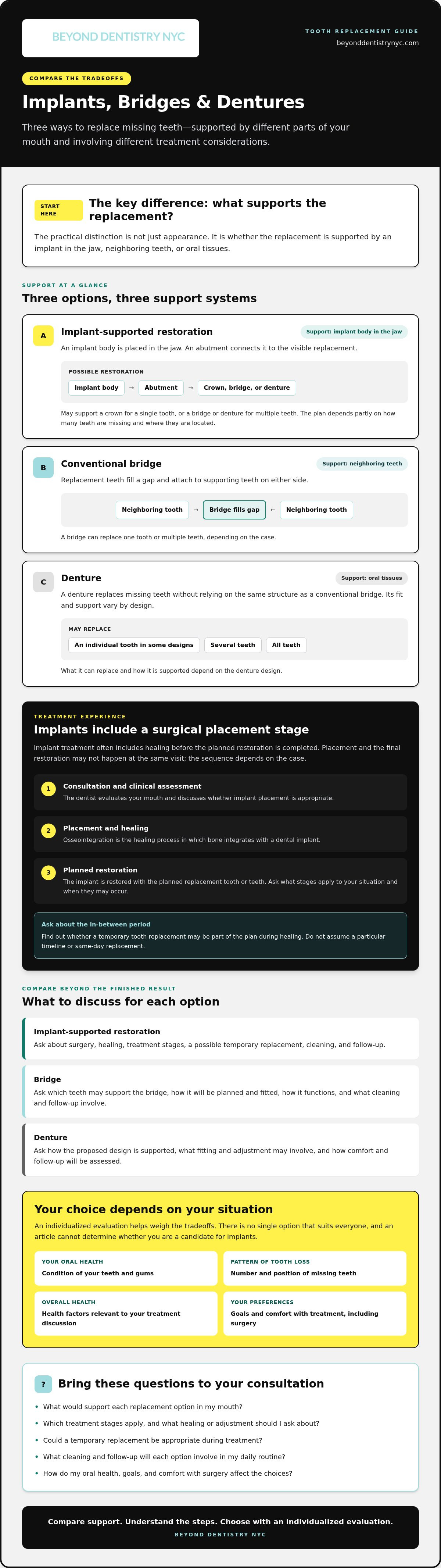
A missing tooth can be replaced in more than one way. The main difference is what supports the replacement: an implant is placed surgically in the jaw, a conventional bridge is supported by neighboring teeth, and a denture rests on oral tissues, though designs vary. Knowing what each option relies on can make a dental consultation more productive.
How an implant-supported tooth is assembled
The implant body is the portion placed in the jaw. An abutment connects it to the visible replacement, which may be a crown, bridge, or denture. These are separate components: the implant provides support, while the restoration replaces the visible tooth or teeth. As outlined in this Dental implant overview, implants can support different types of restorations. The appropriate choice depends partly on how many teeth are missing and where they are located.
How bridges and dentures replace missing teeth
A conventional bridge fills a gap with replacement teeth attached to supporting teeth on either side. Dentures replace missing teeth without relying on that same bridge structure, and their fit and support depend on the design. Before recommending an option, a dentist needs to assess your teeth, gums, and pattern of tooth loss. The comparison below is a starting point, not a way to determine which treatment is right for you.
| Option | Single-tooth replacement | Multiple-tooth replacement | Main support |
|---|---|---|---|
| Implant-supported restoration | An implant may support a crown. | Implants may support a bridge or denture. | Implant body placed in the jaw |
| Conventional bridge | A bridge can fill a single-tooth gap. | A bridge can replace multiple teeth, depending on the case. | Neighboring teeth |
| Denture | Some designs can replace an individual tooth. | Can replace several or all teeth, depending on design. | Oral tissues; support varies by design |
The practical distinction is where support comes from, not simply how the replacement looks. Ask which structures would support each option in your mouth, what restoration is being considered, and how the number and position of missing teeth affect the plan. You can also ask how the options differ in daily cleaning and follow-up. These details help you compare the choices without assuming one approach suits everyone.
How Implant Treatment Differs from Bridge and Denture Treatment
The treatment sequence is another important difference. Implant treatment includes a surgical placement stage and, in many cases, a healing period before the planned restoration is completed. A bridge or denture doesn’t use an implant in the jaw, so planning focuses on the teeth or oral tissues that will support the replacement. The steps and timing depend on your oral health and the restoration being considered.
What happens during implant treatment?
Care typically begins with a consultation and clinical assessment. If implants are being considered, the dentist evaluates your mouth and discusses whether placement is appropriate. Placement is followed by healing, then restoration with the planned replacement tooth or teeth. Ask the clinician to explain which stages apply to your situation and how they fit together.
Osseointegration is the healing process in which bone integrates with a dental implant. Because this takes time, placement and final restoration may not happen at the same visit. Some cases follow a different sequence, including immediate-load options designed to minimize treatment stress; learn more about how specialized surgical approaches can provide fixed teeth without anxiety. Ask what, if anything, can be used to replace the missing tooth during healing and when each stage may occur.
How the bridge and denture process compares
For a bridge, the dentist assesses the gap and the teeth that may support the restoration, then plans and fits the bridge and checks how it functions. Denture care also begins with an assessment, followed by design and fitting, with follow-up to evaluate fit and comfort. The process varies by denture design; MedlinePlus’ guide to dentures offers patient-focused information about types and care.
Neither alternative follows one universal schedule. The condition of nearby teeth, the pattern of missing teeth, and the proposed restoration all shape what’s involved. Ask the dentist to outline the stages, any expected healing or adjustment needs, whether a temporary replacement may be appropriate, and what follow-up will look like. This helps you compare the treatment experience, not just the finished result.
If you’re weighing implant treatment against a bridge or denture, a consultation can connect this general comparison to your health and goals. Discuss tooth replacement options with a dental professional who can assess your individual circumstances.
Implants vs. Bridges and Dentures: Compare the Tradeoffs
Each restoration has different support needs and treatment considerations. Implants involve surgery and healing, while bridges and dentures require their own assessment, design, and fitting process. To make a useful comparison, look at the support each option needs, the stages involved, and the care required for the specific restoration being considered.
| Option | Support | Treatment stages | Maintenance discussion | Questions to ask |
|---|---|---|---|---|
| Implant-supported restoration | Implant placed in the jaw | Assessment, placement, healing, and restoration; sequence varies | Ask how to clean the restoration and care for surrounding tissues | What affects candidacy, healing, and timing in my case? |
| Bridge | Depends on the bridge design; a conventional bridge uses neighboring teeth | Assessment, design, fitting, and follow-up | Ask how to clean around and beneath the bridge | Which teeth support it, and what follow-up is needed? |
| Denture | Oral tissues or other support, depending on design | Assessment, design, fitting, and possible adjustments | Ask about daily cleaning, fit, and review visits | How will this design fit and function for me? |
What to weigh when considering implants
Because implant treatment includes surgery, candidacy and healing deserve an individualized discussion. Overall health and smoking can affect healing, according to the U.S. Food and Drug Administration. Share relevant health information with your dentist and ask how it may shape the plan. You can also ask which implant system is being considered and request its identifying details for your records.
What to weigh when considering bridges or dentures
For a bridge, clarify which teeth would provide support and what that means for those teeth. For a denture, ask which tissues or other structures support its design and how fit and function will be assessed. Because designs vary, don’t assume all bridges or dentures involve the same considerations.
For any option, discuss cleaning, follow-up, and what to do if the restoration feels uncomfortable or changes in fit. Bring your priorities, such as treatment stages, healing, and day-to-day care, into the conversation. The best tooth replacement choice depends on clinical findings and patient priorities. A dentist can help you weigh both, without treating any option as universally superior.
Questions to Help You Choose a Tooth Replacement Option
A consultation is a chance to compare plans in the context of your health, priorities, and the teeth being replaced. You don’t need to decide in advance or assess your own candidacy. Ask the dentist to explain why each option may or may not fit your situation, and what the full process would involve.
Questions about candidacy, risks, and treatment planning
- What clinical findings guide the recommendation? Ask how the condition of your teeth, gums, and surrounding structures affects the suitability of each option.
- How does my health history affect the plan? Share relevant conditions, medications, and whether you smoke. Ask what these factors could mean for treatment risks, healing, and follow-up.
- What stages should I expect? Ask what happens first, what healing or adjustment may be involved, and how the sequence could differ between a bridge, denture, or implant-supported restoration.
- If an implant is recommended, which system is planned? Ask for the system’s identifying details and how to keep them with your treatment records.
Clear answers help you understand both the proposed treatment and why it’s being considered over the alternatives. If a detail is unclear, ask the dentist to explain it in everyday terms.
Questions about daily care and the final result
- How will I clean and maintain this specific restoration? Ask what daily care involves and what follow-up visits are recommended.
- Will I have a temporary tooth replacement? Ask whether a temporary option may be appropriate during treatment, how it would fit into the sequence, and what to expect while waiting for the planned restoration.
- How might the option support my goals? Discuss the appearance and function you hope to achieve, and ask what the proposed restoration can reasonably address. Results and experiences aren’t guaranteed.
- What should I expect after fitting or placement? Ask how the dental team will evaluate fit and function, and who to contact with questions during follow-up.
Bring a written list and note the answers, especially if you’re comparing more than one plan. Focus on how each option fits your health, comfort, daily care preferences, and goals rather than trying to identify a winner on your own.
For a personalized conversation about dental implant options and alternatives, discuss your questions with the team at Beyond Dentistry NYC.
Discuss Dental Implants and Alternatives with a New York Dentist
Implants, bridges, and dentures can all replace missing teeth, but they rely on different forms of support and involve different treatment considerations. An article can help you prepare, but it can’t assess your oral health or determine which option is appropriate. A dentist can review the teeth being replaced, your health, and your priorities before discussing possible approaches.
What to expect from an implant consultation in New York
A consultation is a conversation about your circumstances, not a promise that you’re eligible for a particular procedure. The clinician can review your oral health and goals, explain which replacement approaches may be considered, and outline relevant risks, healing, maintenance, and follow-up. Bring a list of medications or health conditions and any questions you have, including concerns about surgery or being without a tooth during treatment.
Ask how the proposed sequence may differ if you’re considering an implant, bridge, or denture. You might also ask what temporary tooth replacement options could be appropriate and how the final restoration would be cared for. For additional background before your visit, read this New York tooth implant patient guide.
When an implant-focused conversation may help
If you’re weighing an implant against a bridge or denture, a focused discussion can clarify how each option relates to your oral health and goals. Beyond Dentistry NYC is a New York practice that offers dental implants as part of its functional and restorative dentistry services. The practice also provides restorative care using innovative technology treatments.
You don’t need to arrive with a decision already made. Bring your questions, talk through the alternatives, and take time to understand the proposed plan. Discuss your tooth replacement options with Beyond Dentistry NYC.
Take the Next Step With Confidence
Bridges, dentures, and implants can all replace missing teeth, but they rely on different forms of support and involve different treatment steps. The right option isn’t the same for everyone. Your oral health, the teeth being replaced, comfort with treatment, and daily care preferences all belong in the conversation.
A dental consultation can help you understand how each approach may fit your circumstances, what healing or follow-up could involve, and which questions still need answers. Beyond Dentistry NYC offers dental implants as part of its functional and restorative dentistry services, with restorative care that incorporates innovative technology treatments.
You don’t have to arrive with a decision already made. Bring your questions and goals, then take time to consider the options with your dentist. Discuss your tooth replacement options with Beyond Dentistry NYC and take an informed next step toward care that fits your needs.
Frequently Asked Questions
Are dental implants better than bridges or dentures?
There isn’t one option that’s best for everyone. Implants, bridges, and dentures use different forms of support and involve different treatment considerations. Your dentist can compare options based on the tooth or teeth being replaced, your oral health, clinical findings, and treatment preferences. Ask about potential benefits and risks, daily care, and follow-up for each approach so you can make an informed decision that suits your circumstances.
Can everyone get dental implants?
No. Implant treatment isn’t automatically suitable for every person. Overall health, oral conditions, healing considerations, and other individual factors may affect candidacy. The U.S. Food and Drug Administration advises patients to discuss potential benefits and risks with a dental provider. A clinical assessment is needed to review your circumstances and compare implants with bridges or dentures. An online article can help you prepare questions, but it can’t determine whether treatment is right for you.
How long does dental implant treatment take?
The timing varies based on your clinical plan, healing, and the restoration being placed. Treatment may involve implant placement, a healing period for osseointegration, and attachment of the final restoration, though some cases follow a different sequence. Don’t assume every stage happens on the same schedule. Ask your dentist to explain the planned steps, how timing applies to your case, and whether a temporary tooth replacement may be appropriate along the way.
What happens if I choose a bridge instead of an implant?
A bridge replaces missing teeth using support from neighboring teeth, while an implant is placed in the jaw to support a restoration. A bridge may be considered depending on the gap and the condition of the teeth around it. Ask your dentist which teeth would support the bridge, how to care for it, and what follow-up to expect. The comparison should reflect your oral health and available treatment options.
Are dental implants safe?
Dental implants are medical devices, and treatment has potential benefits and risks. No general article can promise that an implant is safe or suitable for a particular person, since health, healing, and other factors vary. Discuss your medical history, possible complications, the proposed implant system, and follow-up with your dental provider. If you have concerns about an existing implant, contact the clinician who treats you for advice tailored to your situation.
How do I care for an implant, bridge, or denture?
Care depends on the specific restoration and your oral health. Ask your dentist to demonstrate how to clean the option being considered, which tools or techniques to use, and when to return for follow-up. Don’t assume an implant-supported restoration, conventional bridge, and denture require identical care. Your clinician can explain how to maintain the proposed restoration and what changes in fit or comfort should prompt you to get in touch.
Does Beyond Dentistry NYC offer dental implant consultations in New York?
Beyond Dentistry NYC lists dental implants among its clinical services in New York City. Contact the practice to confirm current consultation arrangements and discuss whether an implant, bridge, or denture may suit your circumstances. Bring questions about treatment stages, healing, risks, maintenance, and alternatives. A dental provider can review your oral health and goals, explain relevant considerations, and help you understand possible next steps without assuming a particular treatment is right for you.


