

What if the right tooth implant in New York isn’t the one with the boldest promise, but the care plan that fits your health and goals? It’s natural to have questions about candidacy, comfort, healing, and how implant treatment compares with other ways to replace a missing tooth. You deserve clear answers before deciding what comes next.
This guide explains the basic parts of an implant, what the treatment process may involve, and what to compare when choosing a New York dentist. You’ll also find practical questions to bring to a consultation, so you can review your options without feeling rushed.
We’ll look at how the implant, connector, and replacement tooth work together, why an individualized assessment matters, and what to ask about your plan and alternatives. Beyond Dentistry NYC, led by Dr. Morgan Herman and Dr. Michael Herman, offers dental implants and restorative care in New York. A consultation can help clarify which options may suit your circumstances and what information you’ll need to decide.
Key Takeaways
- A tooth implant in New York should be considered as part of an individualized plan, not a one-size-fits-all solution.
- At a consultation, ask how the dentist assessed your needs, why a treatment approach is recommended, and what alternatives may be appropriate.
- Understand the proposed sequence of care, including any additional treatment, restoration, and follow-up.
- Compare implants, bridges, and removable options by how they work and what care they require, then discuss which may fit your circumstances.
- Before choosing a practice, look for clear communication, personalized planning, and an itemized explanation of fees.
What a Tooth Implant in New York Can Replace, and What It Involves
Choosing how to replace a missing tooth can feel like a significant health decision. You may be weighing appearance, daily care, comfort, and the steps involved. A tooth implant in New York is one option to discuss with a dentist, but it isn’t automatically the right fit for every person. An examination and a conversation about your health and goals are needed to assess whether implant treatment is appropriate.
A dental implant is a tooth-replacement treatment made up of components that work together. The implant is placed in the jaw, a connecting component joins it to the replacement tooth, and that tooth fills the space left by the missing one. The Dental implant overview offers background on implant concepts. Your dentist can explain how these parts may apply to your plan. The number and arrangement of components can vary, so an illustration is a guide, not a promise that every treatment follows the same design.
The parts of an implant-supported replacement
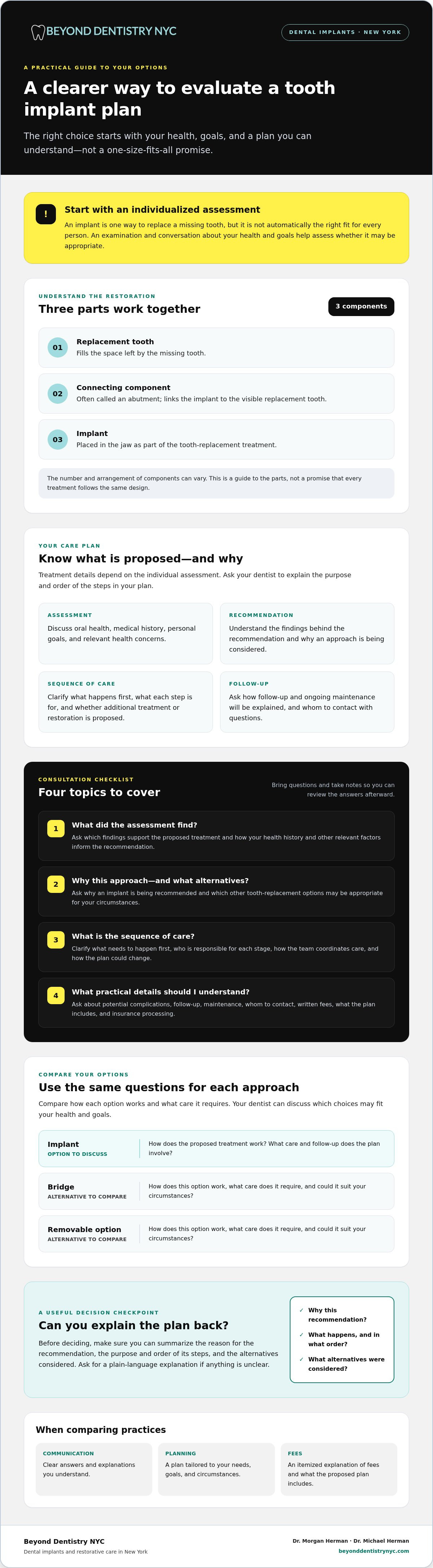
Think of the restoration as a small team of components. The implant is placed in the jaw. The connector, often called an abutment, links it to the visible replacement tooth. That tooth completes the restoration in the space left by the missing tooth.
Simple illustration suggestion: Label a three-part diagram “implant in the jaw,” “connecting component,” and “replacement tooth.” Include a note that the arrangement may differ by treatment plan.
When patients may consider tooth implants
A missing tooth is a reason to ask whether implant treatment could be considered, not a guarantee of candidacy. For example, someone missing a single tooth may want to compare an implant-supported replacement with other options. The clinician’s assessment should take into account oral health, medical history, and personal goals.
Use that discussion to identify what you need to know before choosing a treatment. Ask what the examination revealed, why an implant is or isn’t being considered, and what alternatives may suit your needs. A dentist can explain the reasoning in the context of your circumstances and clarify which parts of the proposed plan are specific to you.
Beyond Dentistry NYC, a New York practice led by Dr. Morgan Herman and Dr. Michael Herman, offers dental implants and restorative care. An individualized discussion can help you understand your options without assuming in advance which approach is best.
How to Evaluate a Tooth Implant Plan in New York
A useful consultation should leave you understanding why a particular approach is being considered, what choices you have, and what happens next. When comparing a tooth implant in new york, focus on the clarity and detail of the plan, not just a provider’s claims. Bring these questions to your appointment and take notes so you can review the answers afterward.
- Start with the findings. Ask what the examination revealed and which findings support the proposed treatment. Discuss your oral health, medical history, and any medications or health concerns you think may be relevant. Ask how those factors inform the recommendation. The assessment should be tailored to you; no single test, image, or procedure is right for every patient.
- Understand the rationale and alternatives. Ask why an implant is being recommended and what other tooth-replacement options may be appropriate. A thoughtful discussion should explain the trade-offs that matter in your circumstances, rather than assume one solution is best for everyone.
- Map out the sequence of care. Ask what each proposed step is for, what needs to happen first, and how the plan could change if your circumstances call for it. Find out which clinician is responsible for each stage and how the team coordinates care.
- Clarify follow-up and practical details. Ask how follow-up and ongoing maintenance will be explained, what potential complications you should understand, and whom to contact with questions. Request written details of fees, what the proposed plan includes, and how insurance processing will be addressed.
Look for a plan you can explain back
After the discussion, you should be able to summarize the reason for the recommendation, the purpose and order of its steps, and the alternatives considered. If any part remains unclear, ask the provider to explain it in plain language before deciding. The FDA’s guide to what you should know about dental implants can help you prepare questions about potential benefits and risks. It doesn’t replace advice based on your individual assessment.
Clear answers matter as much as clinical detail. If you’re exploring care with Beyond Dentistry NYC, you can discuss implant treatment options with the practice and ask how an individualized plan would address your needs.
What Happens During Tooth Implant Treatment, and What Can Vary
Knowing the general stages can make the process feel more manageable, but there isn’t one schedule or sequence that fits every patient. A tooth implant in New York involves assessment and planning, any treatment the clinician considers necessary, implant placement, restoration, and follow-up. Your dentist should explain which steps apply to you and why. Treat this outline as a starting point, not a guaranteed pathway.
From assessment to a personalized plan
The clinician begins by reviewing your oral health, relevant medical history, and goals for replacing the missing tooth. Be open about health conditions, medications, and concerns that might affect care. The dentist determines what assessment is appropriate for your circumstances; don’t assume that specific diagnostic tools or imaging are part of every evaluation.
Once the findings are reviewed, ask the dentist to explain the recommendation, alternatives, and proposed stages in language you understand. If another treatment is needed before placement, ask what purpose it serves and how it affects the overall plan. The American College of Prosthodontists offers information on dental implants for background, but your treating clinician is the person who can interpret your findings.
Placement, restoration, and follow-up
Implant placement is the step in which the implant component is positioned in the jaw. The replacement tooth is attached during the restorative phase according to the plan developed for you. The timing and order of these stages can differ based on individual needs and any other care involved, so ask your clinician what to expect in your case.
Healing experiences and scheduling vary. Rather than relying on a general timeline, ask how the provider will discuss your expected healing, what changes or concerns should prompt you to contact the practice, and how follow-up will be arranged. Request clear home-care instructions and guidance on maintaining the restoration once it’s in place.
Comfort deserves a place in the conversation, too. Tell the dentist if you feel anxious or have concerns about discomfort, and ask what approaches may be available to support you during care. Before each stage, confirm what will happen, whom to contact with questions, and how the next step will be communicated. A clear explanation can help you feel informed without assuming every patient’s experience is the same.
Tooth Implants vs. Bridges and Removable Options: What to Compare
Replacing a missing tooth involves more than choosing how it will look. Consider how each option is placed, how it may involve nearby teeth, and what daily care it requires. A tooth implant in New York may be one option to discuss, but a dentist needs to assess your oral health and situation before recommending an approach.
How the options differ
These descriptions are general starting points, not a ranking. Ask your dentist how each option applies to your needs, including what it means for comfort, maintenance, and everyday use.
| Option | What to discuss |
|---|---|
| Implant-supported replacement | An implant is placed in the jaw and supports a replacement tooth. Ask about the treatment stages, healing expectations, home care, and follow-up. |
| Bridge | A bridge replaces a missing tooth by relying on support from nearby teeth. Ask how those teeth may be involved, how to clean around the restoration, and what care it will need. |
| Removable replacement | This option can be taken out for cleaning. Discuss how it may feel and function in daily life, how to care for it, and what follow-up may be appropriate. |
No option is automatically best for everyone. Your dentist can explain which alternatives are suitable and how they compare in your case. Bring practical questions: Will nearby teeth be affected? What cleaning routine will I need? How might each option fit my comfort and daily habits?
Discussing surgery, healing, and affordability
It’s understandable to have concerns about surgery, discomfort, or recovery. Tell the treating clinician what worries you, then ask them to explain the risks specific to your circumstances, how comfort will be addressed, and what follow-up and healing guidance to expect. Avoid relying on a general timeline or assuming another patient’s experience will match yours.
Cost is another important part of comparing care. Request a written estimate that explains what the proposed plan includes, and ask how fees, insurance processing, and any payment arrangements are handled. Confirm details directly with the practice rather than assuming coverage or payment options.
For an individualized discussion of implant treatment and alternatives, contact Beyond Dentistry NYC to ask about your tooth-replacement options.
Choosing a Tooth Implant Dentist in New York: Your Next Steps
Choosing a provider is about more than finding a practice that offers implants. You should feel comfortable asking questions, understand why a particular plan is being considered, and have a clear picture of the practical details. Use this checklist to compare New York providers before arranging a consultation for a tooth implant in New York.
A practical checklist for comparing New York providers
- Ask how the diagnosis is explained. Can the provider describe the findings that inform a recommendation in language you understand?
- Review the proposed care and alternatives. Does the plan explain the purpose and order of each step, and discuss other options that may suit your circumstances?
- Clarify coordination. Ask who will handle each stage, who will answer questions, and how the practice will explain follow-up.
- Look for individualized planning. The recommendation should reflect your oral health, relevant medical history, and goals, not rely on a one-size-fits-all approach.
- Request written financial details. Ask for an estimate that states what the plan includes, and confirm how insurance processing and payment arrangements are handled. Don’t assume coverage or specific fees.
Clear answers help you compare practices on more than convenience or promotional claims. If something is unclear, ask for an explanation before making a decision.
Discuss implant care with Beyond Dentistry NYC
Beyond Dentistry NYC is a New York practice led by Dr. Morgan Herman and Dr. Michael Herman. The practice offers dental implants and innovative technology treatments. If you’re exploring how oral health considerations fit into a broader care conversation, read about functional dentistry and whole-body oral health. For background on restorative goals, see its guide to smile reconstruction in NYC.
Every patient’s needs are different. If you’d like to discuss your situation and ask what the next consultation step involves, contact Beyond Dentistry NYC for information about an individualized implant-care conversation.
Take the Next Step With Clear Questions
Choosing a tooth implant in New York starts with understanding your needs, not assuming one treatment suits everyone. A thoughtful consultation should explain the findings behind a recommendation, walk through the proposed stages, and help you compare implants with bridges or removable options. It should also leave room to discuss comfort, follow-up, and written financial details.
Bring your questions and relevant health information to the conversation. Ask what the plan involves, why it may fit your circumstances, and what alternatives are worth considering. Clear answers can help you make a decision at a pace that feels comfortable.
Beyond Dentistry NYC offers dental implants and is led by Dr. Morgan Herman and Dr. Michael Herman. If you’d like to discuss your questions and learn about the next step for an individualized consultation, contact Beyond Dentistry NYC.
You don’t need to have every answer before reaching out. A conversation can help you understand your options and decide what feels right for you.
Frequently Asked Questions
Am I a candidate for a tooth implant?
Only an individualized dental assessment can determine whether implant treatment may be appropriate for you. A New York dentist will consider your oral health, relevant medical history, and goals, then explain the findings and options. Having a missing tooth is a reason to ask about a tooth implant in New York, but it doesn’t guarantee that an implant is the recommended choice. Share health conditions and medications so the clinician can consider them in your plan.
How long does tooth implant treatment take?
The treatment timeline varies, so your dentist is best placed to explain what to expect in your case. Assessment, planning, any additional treatment, implant placement, restoration, and follow-up may occur in stages. Healing and scheduling depend on individual circumstances, so be cautious of a timeline presented as universal. Ask which steps are included in your plan, what could affect their timing, and how the practice will keep you informed about next steps.
Is getting a tooth implant painful?
Each patient’s experience is different, so your dentist should explain what you may feel during treatment and recovery rather than promise a particular outcome. If discomfort or anxiety is a concern, mention it before care begins. Ask what comfort measures may be appropriate, how the team will communicate during treatment, and whom to contact with concerns afterward. Understanding the plan and knowing how questions will be handled can help you feel more prepared.
How much does a tooth implant cost in New York?
The cost depends on your individual treatment plan, so request a written estimate from the practice rather than relying on a general figure. Ask what the estimate includes and whether it accounts for each proposed stage or any additional care the dentist recommends. Confirm how insurance processing is handled and what information you may need from your insurer. Don’t assume a quoted amount includes every part of treatment or that insurance will cover a specific item.
Are tooth implants better than bridges?
Neither option is best for every patient. An implant-supported replacement and a bridge differ in how they’re placed, the role of nearby teeth, and the care each may require. A dentist can assess your situation and explain whether either option, or another alternative, may be appropriate. Ask about daily cleaning, comfort, maintenance, and how each plan fits your oral health and goals before comparing recommendations.
What should I ask a New York implant dentist before treatment?
Ask what findings support the recommendation, what alternatives may suit you, and what each stage of the proposed plan involves. Clarify who coordinates care, how follow-up and home care will be explained, and what potential complications to discuss. Request written details of fees and what the plan includes, then confirm how insurance processing works. Share relevant health history and ask how it affects the recommendation. Clear answers should help you make an informed decision.


