

What if the secret to a restful night isn't just a machine you wear, but the way you train your own body to breathe? If you've spent your mornings in Manhattan dragging through meetings because of chronic fatigue, you're not alone. An estimated 80.6 million US adults have obstructive sleep apnea, yet many struggle with the fear of using a bulky CPAP machine. You deserve to wake up feeling refreshed and ready for the city's pace. Many of our patients find that while oral appliance therapy for sleep apnea nyc provides immediate structural support, there's another layer to the puzzle that often goes overlooked.
You'll learn how specific neuromuscular exercises can strengthen your airway and complement oral appliance therapy for lasting sleep apnea relief. We'll explore the science of myofunctional therapy, which is a non-invasive approach that addresses the root muscular causes of airway obstruction. It's about more than just a device; it's about functional health. We're going to provide a clear plan for airway-focused dental care that prioritizes your comfort, reduces snoring, and improves your oxygen intake. Let's look at how this modern approach can finally silence the noise and restore your vitality.
Key Takeaways
- Understand how myofunctional therapy acts as "physical therapy" for your throat, addressing the muscular weakness that leads to airway collapse.
- Discover the science of neuromuscular re-education and why maintaining a proper tongue-to-palate resting posture is vital for uninterrupted breathing.
- Learn five foundational exercises designed to strengthen your airway in just minutes a day, provided you have professional guidance from an airway-focused dentist.
- Explore why combining exercises with oral appliance therapy for sleep apnea nyc offers the most comprehensive solution by addressing both muscle tone and structural support.
- See how a personalized functional airway assessment can transform your sleep quality and restore your daytime energy.
What is Myofunctional Therapy for Sleep Apnea?
Oropharyngeal Myofunctional Therapy (OMT) is essentially physical therapy for the mouth and throat. While many people think of sleep apnea as a static blockage, it is often a dynamic issue involving muscle tone and coordination. To understand What is Sleep Apnea?, we have to look at the concept of airway collapsibility. When the muscles of the tongue, soft palate, and throat are weak, they lack the "tone" required to stay open during sleep. As you relax, these tissues succumb to gravity, narrowing or closing the airway entirely. This leads to the characteristic gasping and interrupted breathing patterns that define the condition.
In our practice, we utilize functional dentistry to identify these underlying muscle imbalances. We don't just look at your teeth; we examine how your tongue rests, how you swallow, and the overall strength of your orofacial complex. This non-invasive approach serves as a powerful, supplemental tool alongside traditional treatments like oral appliance therapy for sleep apnea nyc. By training the brain to keep these muscles active even during deep rest, we address the functional cause of the obstruction rather than just managing the symptoms.
The Connection Between Muscle Tone and Snoring
Snoring isn't just a nuisance for your partner; it's a vital warning sign of a compromised airway. When you enter deep sleep, your muscles naturally relax. If the soft palate or the base of the tongue is "floppy" due to poor tone, it begins to vibrate against the back of the throat as air passes through. This is known as a functional obstruction. It differs significantly from structural obstructions, such as enlarged tonsils or a deviated septum, which may require surgical intervention. Strengthening these "floppy" tissues through targeted exercises can reduce vibrations, leading to quieter nights and significantly better oxygen intake.
Why NYC Patients are Turning to Functional Airway Care
Living in Manhattan involves managing high-pressure environments that can subtly impact our physiology. Chronic stress and the "tech neck" posture common in office settings often lead to mouth breathing and shallow respiration patterns. Many of our patients are actively seeking "NYC-lifestyle-friendly" solutions that avoid the bulk, noise, and maintenance of a CPAP machine. By working with a Manhattan-based specialist who understands the airway-focused dental model, you can address these habits holistically. We focus on the deep connection between your oral health and your whole-body wellness, ensuring that your plan for oral appliance therapy for sleep apnea nyc is supported by a strong, functional foundation.
The Science: How Exercises Strengthen the Airway
Neuromuscular re-education is the core of this science. It's the process of training the brain to maintain muscle activity while you're asleep. Most people think sleep is a time of total muscle shut-down, but for a healthy airway, certain muscles must stay "online." The tongue is the primary rudder of your airway. Where it goes, the airway follows. If your tongue rests at the bottom of your mouth, it's more likely to slide back and block your breathing. However, by practicing a "Tongue-to-Palate" resting posture, you create a natural internal brace that keeps the passage clear.
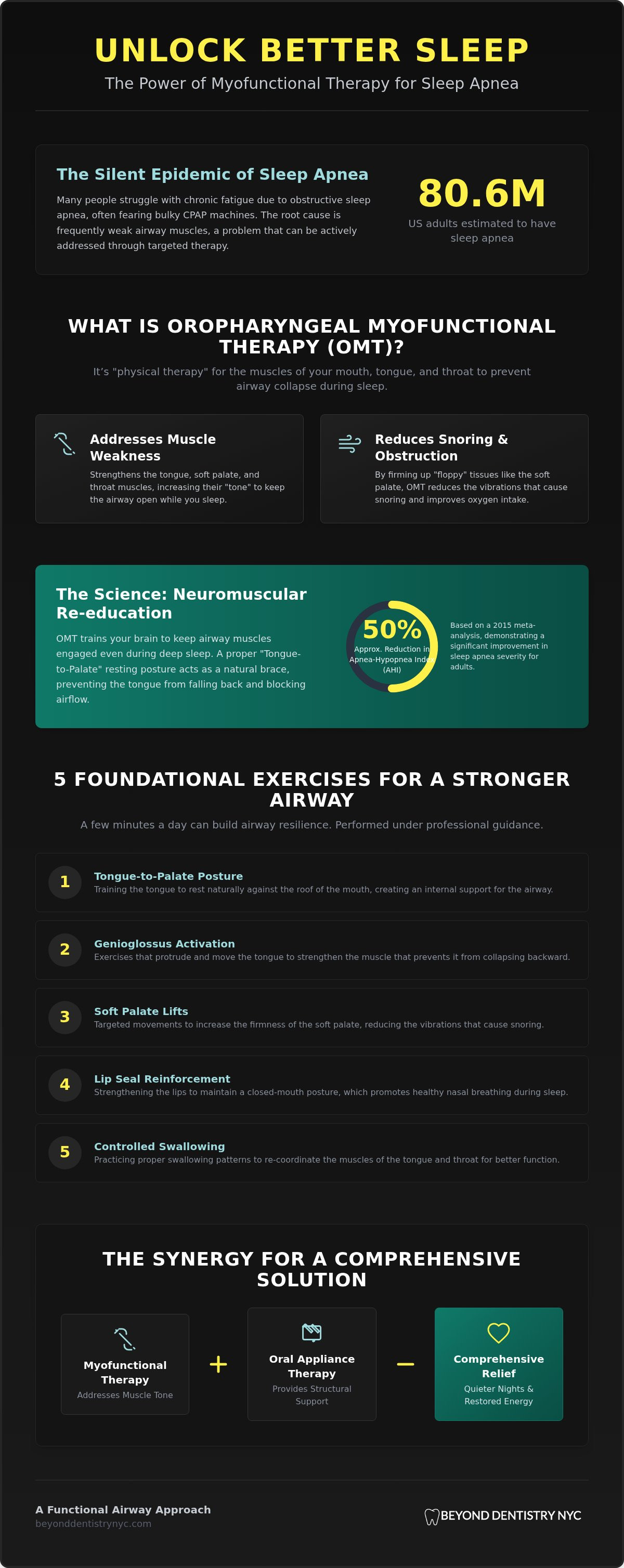
The results are backed by clinical data. A 2015 meta-analysis found that myofunctional therapy can reduce the Apnea-Hypopnea Index (AHI) by approximately 50% in adults. This significant improvement demonstrates that while oral appliance therapy for sleep apnea nyc is excellent for structural support, strengthening the muscles provides a functional safety net. It makes any device you wear more effective because your body is finally doing its part to stay open.
Targeting the Oropharyngeal Muscles
We focus heavily on the genioglossus muscle, which is the primary muscle responsible for protruding the tongue. When this muscle is properly toned, it prevents the tongue-drop that causes most obstructions. Similarly, the muscles of the soft palate need enough tension to prevent the vibrations we recognize as snoring. Maintaining a firm lip seal is another critical component, as it promotes healthy nasal breathing and prevents the drying out of airway tissues. Integrating 5 myofunctional therapy exercises into your daily routine can help build this necessary resilience.
Functional Dentistry vs. Traditional Sleep Medicine
Traditional sleep medicine often focuses solely on the symptoms of obstruction, but Dr. Morgan and Dr. Michael Herman take a different path. Our approach at Beyond Dentistry NYC focuses on the root cause of airway collapse. We look for early signs of mouth breathing habits that might have been present for years. Using innovative technology treatments, we can map your functional needs with precision. This allows us to determine if you need a specific type of oral appliance therapy for sleep apnea nyc or if a combination of OMT and structural support is the best way to restore your vitality. It's about looking at the whole person, not just a single symptom.
5 Essential Myofunctional Therapy Exercises for Better Sleep
Consistency is the foundation of success when it's time to retrain your airway. Just like any other fitness routine, you won't see results overnight; you need to dedicate 10 to 15 minutes a day to these movements. Before you begin, it's essential to consult an airway focused dentist to ensure these specific exercises align with your physiological needs. While these movements are non-invasive, they're most effective when they're part of a broader plan for oral appliance therapy for sleep apnea nyc. For the Tongue Slide, you should press the tip of your tongue to the back of your top front teeth and slowly slide it backward along the roof of your mouth for 5 seconds.
To get started, focus on these five foundational movements:
- The Tongue Press: 15 repetitions of 10-second holds.
- The Tongue Click: 20 sharp repetitions to engage the tongue base.
- The Vowel Stretch: 10 cycles of exaggerated "A-E-I-O-U" sounds.
- The Tiger Yawn: 10 repetitions to lift the soft palate.
- The Button Pull: 5 minutes of resisted lip-seal training.
Exercise 1 & 2: Tongue Strengthening
The tongue is a powerful muscle that often loses its "shape" over years of poor posture. To perform the Tongue Press, push the flat surface of your tongue firmly against the roof of your mouth and hold the tension for 10 seconds. Follow this with the Tongue Click, where you press the tongue against the palate and pull it down to create a loud, sharp clicking sound. Aim for 15 to 20 repetitions of each. These movements engage the genioglossus muscle, preventing it from collapsing into your airway during the night.
Exercise 3 & 4: Soft Palate and Throat Toning
Your soft palate acts like a curtain that can block your breath if it's too relaxed. The Vowel Stretch involves pronouncing "A-E-I-O-U" with exaggerated mouth movements to engage the deep throat muscles. Next, try the Tiger Yawn: open your mouth wide as if you're yawning and try to lift your soft palate so you can see your uvula in the mirror. Watch for that upward lift to ensure you're targeting the right tissues. Repeating this 10 times daily helps maintain the tension needed to prevent snoring and maintain a clear passage.
Exercise 5: Lip and Cheek Seal
A strong lip seal is the gatekeeper for healthy nasal breathing. The Button Pull is a classic tool where you place a large button on a string behind your lips, not your teeth, and pull the string while using your lip muscles to hold the button in place. Strengthening these muscles encourages you to keep your mouth closed during the day, which directly leads to better breathing at night. This lip strength is a vital component when you're using oral appliance therapy for sleep apnea nyc, as it helps keep the jaw in the ideal position for oxygen intake.
Beyond Exercises: The Synergy of Oral Appliance Therapy
Retraining your muscles is a vital piece of the puzzle, but it rarely acts as a total cure on its own. A common question we hear in our Manhattan office is whether exercises alone can replace professional dental intervention. While myofunctional therapy addresses the "software" of your breathing by toning the tissues, oral appliance therapy for sleep apnea nyc provides the "hardware" or the structural support your airway needs to stay open. Think of it as a synergy effect: the exercises ensure your tongue and throat don't collapse, while the appliance holds your jaw in the optimal position to maximize airflow.
This combined approach is a hallmark of functional dentistry. By addressing both the muscle tone and the physical structure of the airway, we create a more stable environment for rest. This dual strategy also protects your long-term jaw health. Without proper muscle tone, a patient might rely too heavily on an appliance, potentially leading to strain on the temporomandibular joint (TMJ). When we balance the two, we ensure that your sleep apnea relief doesn't come at the cost of TMD discomfort. The success of oral appliance therapy for sleep apnea nyc often depends on this holistic view of how your mouth and throat function as a single system.
How Custom Sleep Appliances Work
The most common tool we use is the Mandibular Advancement Device (MAD). These sleep apnea appliances are custom-designed to gently shift the lower jaw forward. This subtle movement keeps the tongue and soft tissues from falling back into the throat. It's important to distinguish these from "boil and bite" drugstore mouthguards, which are often dangerous for sleep apnea patients. Generic guards can actually push the jaw backward or cause permanent bite changes. For NYC professionals who cannot afford a single night of poor rest, a custom-fit device is the only way to ensure both safety and efficacy.
Combining OMT with Innovative Technology
At Beyond Dentistry NYC, we use digital scans rather than messy traditional impressions to create your device. This innovative technology allows for a level of precision that makes the appliance feel like a natural part of your mouth. As your myofunctional exercises begin to improve your muscle tone, we monitor your progress closely. Over time, as your airway becomes naturally more resilient, we may be able to adjust your appliance for even greater comfort. The ultimate goal is a stable airway that requires less "heavy lifting" from the device because your body has regained its natural strength. If you're ready to explore a customized approach to your sleep health, schedule your functional airway assessment with our team today.
Starting Your Journey at Beyond Dentistry NYC
Walking into our NYC office shouldn't feel like entering a sterile medical facility. We've carefully cultivated an atmosphere that balances clinical excellence with a warm, family-oriented touch. Dr. Morgan and Dr. Michael Herman understand that sleep issues often come with a heavy burden of anxiety and exhaustion. That's why our approach to oral appliance therapy for sleep apnea nyc is designed to feel like a compassionate partnership. You aren't just another patient on a chart; you're a neighbor looking to reclaim your vitality in a city that never stops. We focus on the positive outcomes of your care, ensuring you feel supported from your very first visit.
Integrating these life-changing exercises into a relentless Manhattan pace doesn't require a total lifestyle overhaul. Many of our patients find success by practicing their tongue presses during their morning subway commute or performing soft palate stretches while preparing for a high-stakes meeting. It only takes about 10 to 15 minutes a day, yet the cumulative impact on your sleep quality can be profound. By working closely with our team, you'll learn how to weave these functional habits into your existing routine, making your path to better breathing feel natural and sustainable.
The Functional Airway Assessment
This is where your journey truly begins. We look much deeper than a standard dental checkup. During your initial assessment, we evaluate critical factors like tongue tie, palate shape, and overall muscle tone to understand exactly why your airway collapses during rest. By using digital diagnostics, we can visualize the structural and functional nuances that traditional exams often miss. This assessment provides a clear, data-driven roadmap for your specific sleep and breathing goals. It ensures every exercise and every adjustment to your appliance is tailored to your unique anatomy.
Your Manhattan Destination for Better Sleep
Our practice is conveniently located for NYC professionals who need to prioritize their health without sacrificing their productivity. While we don't offer weekend appointments, our weekday schedule is designed to accommodate the needs of a busy Manhattanite. We maintain a steadfast focus on "Comfort and Ease" throughout the entire clinical process, from the first digital scan to the final appliance fitting. This is your invitation to finally stop managing chronic fatigue and start living with the energy you deserve. Reclaiming your health is a journey, and we're here to guide you every step of the way toward a quieter, more restful night.
Reclaim Your Rest and Vitality
Restoring a healthy airway is about more than just wearing a device; it's about retraining your body to function at its best. By combining the muscle-toning power of myofunctional therapy with the structural support of oral appliance therapy for sleep apnea nyc, you address the root causes of breathing interruptions. This dual approach ensures that your sleep isn't just managed, but truly restored. You don't have to settle for chronic fatigue when a functional, holistic path is available right here in Manhattan.
Under the expert guidance of Dr. Morgan and Dr. Michael Herman, you'll benefit from functional dentistry that prioritizes your individual comfort and whole-body health. Using innovative technology treatments, we create custom-crafted sleep apnea appliances that fit seamlessly into your high-pressure lifestyle. It's time to wake up feeling refreshed and ready for everything the city has to offer. We're committed to helping you navigate this journey with ease and confidence.
Schedule your functional airway assessment at Beyond Dentistry NYC today and take the first step toward lasting relief. Your journey to better sleep starts with a single, supportive conversation. We look forward to helping you breathe easier and live better.
Frequently Asked Questions
How long does it take for myofunctional exercises to work for sleep apnea?
Patients typically begin to see measurable improvements in their breathing and muscle tone within six to twelve months of consistent daily practice. While some individuals report a reduction in snoring or improved daytime energy after just a few weeks, the process of neuromuscular re-education requires time for the brain and muscles to synchronize. Consistency is vital for these changes to become permanent, ensuring your airway remains resilient during deep sleep cycles.
Can myofunctional therapy cure sleep apnea entirely?
Myofunctional therapy is an exceptionally effective management tool that can reduce the severity of sleep apnea, but it isn't always a standalone cure. For many patients, the condition is caused by a combination of muscle weakness and structural anatomy. While strengthening the oropharyngeal muscles can significantly lower your Apnea-Hypopnea Index (AHI), most people achieve the best results when combining these exercises with oral appliance therapy for sleep apnea nyc to provide physical support.
Are these exercises the same as tongue-tie exercises?
There is significant overlap between the two, but they serve different primary goals. Tongue-tie exercises specifically focus on increasing the range of motion after a frenectomy, while myofunctional therapy for sleep apnea targets the overall tone and endurance of the entire throat and soft palate. We customize your routine based on your specific functional airway assessment, ensuring that we address the exact muscles responsible for your nighttime airway collapse rather than using a generic approach.
Do I still need a CPAP if I do these exercises every day?
You should never stop using your CPAP machine without a definitive recommendation from your sleep physician. While these daily exercises are designed to strengthen your airway, the decision to transition away from CPAP depends on the results of a follow-up sleep study. Many patients find that as their muscle tone improves, they become excellent candidates for oral appliance therapy for sleep apnea nyc, which offers a much more comfortable and travel-friendly alternative to bulky machinery.
What happens if I stop doing my myofunctional therapy exercises?
Just like any other form of physical fitness, the benefits of myofunctional therapy can diminish if you stop the exercises entirely before the new muscle patterns are fully habituated. Without regular engagement, the muscles of the tongue and throat may eventually lose the tone required to stay open during sleep. We focus on reaching a maintenance phase where you only need to perform the movements a few times a week to keep your airway stable and healthy.
Is myofunctional therapy for sleep apnea covered by insurance in NYC?
Insurance coverage for myofunctional therapy in New York can be inconsistent and varies significantly between different providers. It isn't typically listed as a standalone benefit, but it's sometimes covered when billed under speech-language pathology or swallowing therapy if deemed medically necessary. We recommend contacting your medical insurance carrier directly to verify your specific benefits. Our team is always here to provide the necessary documentation to help you navigate your claims process with confidence.
Can children benefit from these airway exercises too?
Children often see even more dramatic results than adults because their jaws and airways are still developing. Implementing these exercises early can help guide proper facial growth and encourage healthy nasal breathing habits from a young age. By addressing muscle imbalances early, we can often prevent more severe sleep issues or orthodontic complications later in life. It's a gentle, non-invasive way to support your child's long-term health and ensure they wake up feeling rested.
What is the best time of day to perform these exercises?
The best time to perform your exercises is whenever you can be most consistent, though many patients find success by habit stacking them with their existing routines. Morning and evening are popular choices, as you can easily practice while showering or during your commute into Manhattan. The goal is to make these movements a natural part of your day. Spreading the 10 to 15 minutes of work across several short sessions can also prevent muscle fatigue.


